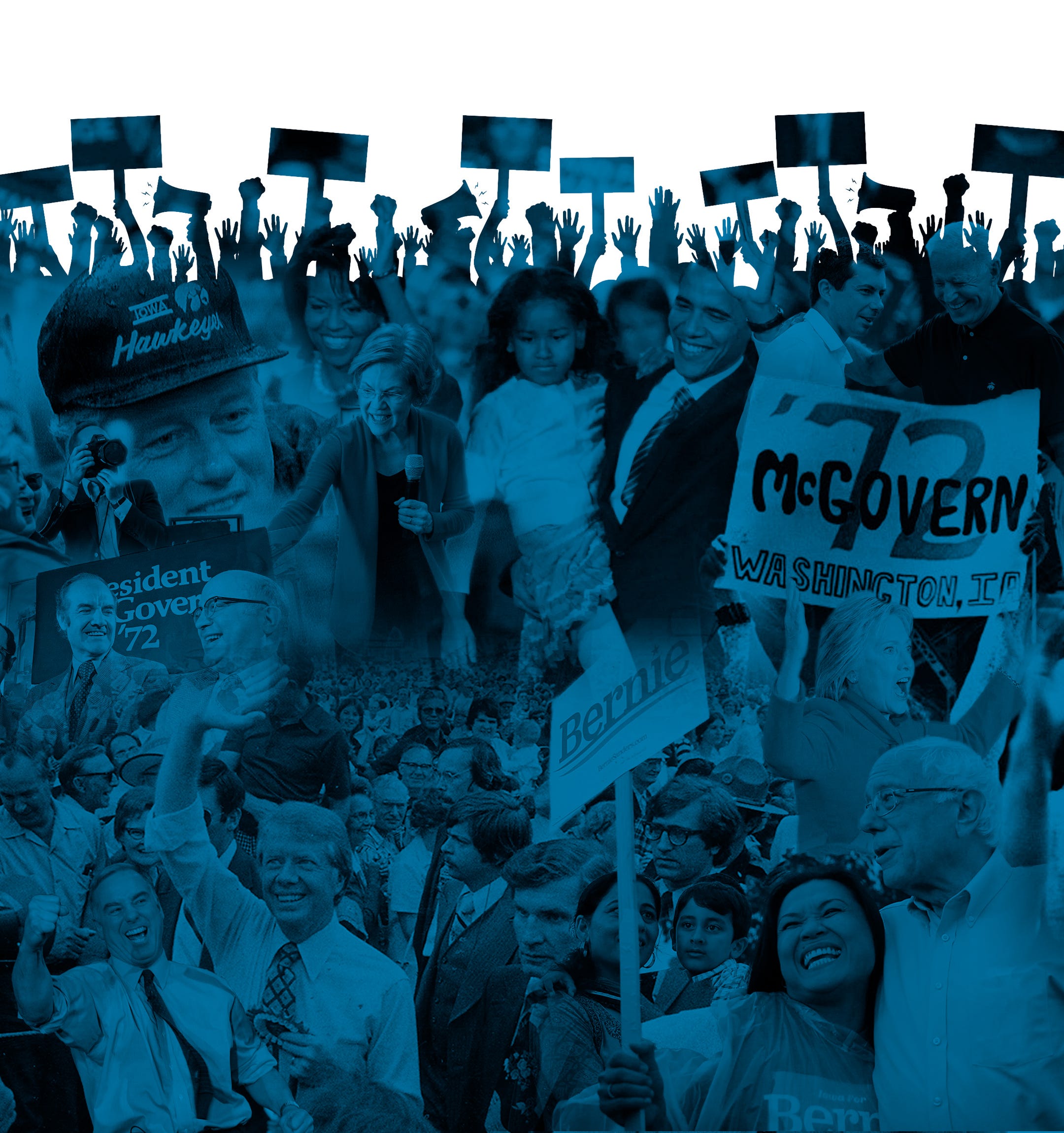
The death of the Iowa Democratic caucus: How 50 years of jury-rigging doomed an American tradition
On the other end are well-intentioned Iowans with earnest questions, news stations demanding updates, pranksters clogging the lines and, most critically, precinct captains from across the state trying in vain to report the results of their local caucuses.
The 2020 Iowa Democratic caucuses have so far sidestepped the previous cycle’s problems — long waits, overcrowded precinct sites — but now, behind the scenes, the system is falling apart. And fast.
At a brief training a few days earlier, the call center volunteers at the Iowa Democratic Party’s caucus night headquarters — the so-called “boiler room” — were told to bring books, puzzles and games. Party leaders didn’t anticipate they’d be busy for hours.
Now, bathed in the glare of a cold conference room’s fluorescent lights, they grapple with waves of panic and frustration over their immediate task: gathering Iowa caucus results and relaying them to the waiting world.
Sheets of poster paper tallying the types of problems callers are registering hang on the wall — “chairperson not present,” “delegate misallocation,” and “where is my caucus location?”
But the effort is abandoned in the frenzy — the cascade of tick marks next to “app problems” dwarfing all others. Volunteers had never seen the app — designed in haste to allow supposedly easy tabulation and transmission of caucus night results — nor been trained to use it.
When precinct captains are able to get through the congested phone lines, volunteers begin an on-the-fly paper-and-pen filing system for the complicated and arcane caucus math that has baffled even some of the biggest caucus aficionados for decades.
If the results don’t make sense or the numbers don't add up, volunteers deposit the records into a cardboard box with the words “still f---ed” scrawled across the side in Sharpie.
The “still f---ed” box is filling quickly.
“The people in that room know what the f--k they’re doing. They’re smart people,” one volunteer says at the time. “But none of them had been trained. So they’re all just making s--t up on the fly.”
The party had gone through tabletop exercises to prepare for a range of disaster scenarios. There are response plans if the city of Des Moines suddenly loses power, say, or if the Russians hack into their computers.
But if the new app fails and everyone with a stake in the future of the American presidency suddenly floods the backup phone lines instead?
There is no plan for this.
From consensus to chaos: Cracks create chasms in the Iowa caucus
Through a combination of luck, grit and political inertia, Iowa has held the leadoff role in the presidential nominating process for five decades — a role that has come to define the very identity of the state and many of its inhabitants. As a result, the small, mostly white state otherwise known for its corn and hog production has wielded unparalleled influence in electing the leader of the free world.
And in 2020, the free world itself seemed to hang in the balance for Iowa Democrats who were determined to unseat Republican President Donald Trump — a pseudo-populist leader who had spent the first years of his presidency undermining every idea Democrats held dear. The urgency of the task — finding a nominee up to the challenge of beating him — seemed to hang like a weight around their necks as they spent months wading through the massive field of Democratic contenders, desperately looking for a winner.
A botched caucus night could put all their efforts in jeopardy.
But the 2020 Democratic caucuses had been threatened from the start.
For years, a growing chorus of voices had said Iowa was no longer up to this herculean task of leading off presidential voting: that not only did the state fail to represent the increasingly diverse face of the Democratic Party, but that the caucus framework itself — a series of town meetings that require people to physically gather to debate for hours in the hope of finding consensus — actively undermined the party’s highest ideals of inclusion.
Over time, the national party sought to move away from the esoteric and antiquated caucus system in favor of simpler, more democratic primary elections, which can deliver a vote count quickly and with relative precision. And Iowa’s leaders, bound by law to hold caucuses rather than primaries, had obliged as much as possible, slowly contorting an inherently casual and volunteer-driven system into an amalgamation that often fell short.
Still, national leaders in the 2020 cycle pushed even harder for Iowa to adopt new rules aimed at fostering transparency, inclusivity and real-time results. And again, Iowa’s Democratic Party leaders sought to tweak the process to meet those demands as best they could.
But years of new addition after new addition had made the Democrats’ whole caucus structure feel off-kilter. By the time 2020 candidates started stumping, even one more request threatened to trigger its collapse.
On caucus night, as volunteers struggle against the phones, it’s clear the roof is starting to cave in.
Nearby, Iowa Democratic Party Chair Troy Price sits in his green room, feeling similarly helpless. His team is supposed to oversee the whole operation, supposed to ensure a polished event. But as the chaos turns from a rumble to a roar, the Democratic National Committee steps in to help manage the ballooning crisis.
DNC representatives begin appearing every 10 minutes to tell Price they hope to have an answer in just 10 more minutes.
Now, he waits for news — just like everyone else.
Chain-puffing on an e-cigarette, he removes his Apple Watch to stop the incessant buzzing of notifications. Angry campaigns are “blowing us up seven ways till Sunday,” he says later, while hordes of journalists from around the world are demanding results — or at least some explanation of the delay.
And the special tech team brought in to deal with the swelling app problems still hasn’t ruled out a hack.
Price’s watch reads 9 p.m. The long night has barely begun.
With precinct captains still turning off lights in the high school gyms, churches and community centers where neighbors had just caucused, cable news pundits are already declaring the entire process completely and irreparably screwed.
"I just think the idea of the caucus has failed to reach the viability threshold," Van Jones says on CNN. "This is starting to feel like a real debacle."
Across the state, Iowans begin asking themselves in flurries of text messages and barroom conversations, “Is this the end?”
More than two years later, in a subdued vote in a swanky D.C. hotel’s conference room, members of the DNC’s Rules and Bylaws Committee have decided that the spectacular crash of the 2020 caucus was indeed the end, voting to replace Iowa with South Carolina at the front of the nominating calendar.
But Iowa’s first-in-the-nation Democratic caucuses — the result of a happy accident that has, nonetheless, created and shaped presidential candidacies for 50 years — were doomed long before a few lines of code failed on Feb. 3, 2020.
Noon, Caucus Day 2020: As Iowans vote, problems slowly emerge
In Ottumwa, a blue-collar Iowa town buoyed by an influx of immigrants, just over a dozen Ethiopian pork plant workers gather in the corner of a union hall, among the very first Americans in 2020 to weigh in on the nation’s next president.
In this moment at least, the Iowa Democratic Party’s efforts to reach new participants who might otherwise be excluded seem successful.
Sporting signs and smiles, these newly minted Iowans are dedicated to U.S. Sen. Bernie Sanders.
Sanders' staffers had set up outside the JBS pork plant at shift change — between midnight and 2 a.m. — hoping to persuade workers that not only was Sanders’ vision the right one for the country, but that their voices were important enough to be heard.
Convinced, they show up to the state Democratic Party’s first Iowa satellite caucus of the day, and they net Sanders his first, tiny victory — a perfect microcosm of what organizers say the caucuses, at their most basic level, are about.
This is one of more than 80 “satellite caucuses” held across the world at times and places not usually accounted for in Iowa’s traditional 7 p.m. meetings — all part of the national party’s demand for change after the 2016 election.
Iowa’s caucuses are exclusive by design, requiring participants to gather in person at a set time and place to show their public support for a candidate. Shift workers, single parents, those with disabilities or without transportation have faced significant barriers to participation.
The new satellite caucuses seemed, at this early stage, to be a welcome opening for an expanded electorate. But they accounted for a small fraction of Caucus Day precincts.
To further increase inclusivity, local leaders had pitched hosting virtual caucuses — where participants would caucus by phone rather than show up at a location — but the DNC rejected that plan, citing cyber security concerns.
The DNC also demanded that, in an effort toward transparency, Iowa report out three separate sets of data: Iowans’ first choice, their second choice and the “state delegate equivalent,” the figure that is traditionally used to determine the evening’s victor. With a dozen possible candidate choices at about 1,700 sites, Iowa leaders could expect more than 60,000 data points.
This change would lift the curtain for those skeptical of Iowa’s process, but it would also give the public more ways to check the numbers and calculations for themselves.
The results had to be right.
To help manage the new reporting requirements, the state and national parties collaborated on an app that allowed precinct leaders to report results and streamlined how the public could access them.
But confusion and infighting between the state and national parties pushed the app’s development back significantly, leaving just over three months to create and test it — instead of the seven months that Shadow, the developer, had requested. The delays meant that instructions on using the app were not included in the more than 180 virtual and in-person trainings held in the run-up to the caucuses.
Instead, when the app launched on Jan. 18, just two weeks before Caucus Day, precinct chairs were expected to decipher an elaborate login process by reading a 34-page “user manual.”
The app is already beginning to show signs of distress as reporters in Ottumwa happily snap photos of the diverse first 2020 caucus on U.S. soil.
The app has been layered with security precautions at the insistence of the DNC, which wanted to double-check the results in its own systems before any numbers were released — despite the Iowa party already instituting its own quality controls before posting the data. The national party’s request required that coders create a last-minute conversion tool so the app and the DNC’s system, which used different formats, could share data.
As Caucus Day kicks off, app developers and DNC party engineers are still correcting errors. And all those patches mean that Chairman Price and other local leaders haven’t even had a chance to use the app themselves.
Born to lift up the rank and file, the modern Iowa caucuses were never about winning
Armed with just two telephone lines and a memory-enabled calculator, Richard Bender tallied the results for the 1972 Democratic caucuses as about a dozen journalists tried to stay warm against frigid wind chills while waiting for results.
“I collected the data for the entire state on that calculator,” said Bender, a longtime Iowa Democrat who helped craft the caucus system.
Iowa going first that year was a bit of a fluke, the fortunate result of a slow-printing mimeograph machine, the archaic-looking predecessor to a photocopier.
The party planned to hold its state convention in May, and before that, there needed to be district conventions, county conventions and precinct caucuses. New sets of documents would need to be printed for each, and the mimeograph moved slowly, so they’d have to start early. Precinct caucuses had to be held in January to make the timeline work.
“We wanted to be first, but there was no perception that being first would be that big a deal,” Bender said in a recent interview.
Until that point, presidential primaries were nonbinding public shows of support. And no matter what that public support showed, party bosses were free to nominate their own preferred candidates at the national convention.
“Generally, you didn't get the nomination by running in primaries,” said Dennis Goldford, a Drake University political science professor and caucus scholar. “Primaries were a way more of getting the attention of party elites who control the nomination, rather than accumulating delegates.”
But frustration boiled over at the 1968 Democratic National Convention in Chicago when party leaders ignored popular support for anti-war candidate Eugene McCarthy and instead nominated Hubert Humphrey, who hadn’t won a single primary.
Demand for change followed, and states were instructed to adopt reforms that opened the nominating process to more rank-and-file Democrats as well as women, minorities and young people.
The early favorite for the 1972 nomination was Edmund Muskie, a senator from Maine and the preferred candidate of party bosses.
“It was assumed by the political press that (Muskie) would win the New Hampshire primary almost automatically,” Gary Hart said in a recent interview with the Register.
Hart would later run for president himself and serve two terms in the U.S. Senate. But at the time, he was a young political operative hired to help run a long-shot campaign for anti-war candidate U.S. Sen. George McGovern.
Looking for a way to get a jump on Muskie before New Hampshire, he and another staffer, Rick Stearns, landed on Iowa’s caucuses — a contest that most other politicians, including Muskie, were ignoring.
The dynamics of a caucus — with lower turnouts and cheaper costs than a primary — lent themselves well to grassroots, volunteer-driven organizing. Shoe leather, not wallets, could make the difference, they believed. And tapping into anti-war sentiments in Iowa could build an army of dedicated caucusgoers who might deliver McGovern a victory.
Or at least a headline.
“We had very little money. But we had volunteers,” Hart said. “And volunteers knock on doors and recruit everyday Democrats to support their candidate. So, we decided to compete in the Iowa caucuses and try to make a showing that would demonstrate that George McGovern had grassroots support at the local level.”
Muskie’s campaign relied on county chairs and establishment bosses, Hart said. “Older white males were, by and large, traditionalists and Muskie supporters, but not with a huge amount of conviction,” he said.
McGovern on the other hand “had become the champion of opening the doors of the party to women, to minorities and to young people. So we had an awful lot of young people volunteers. It was a movement.”
The long shot was drawing out a new kind of hyper-engaged caucusgoer — which was the point.
On caucus night 1972, blizzard conditions swept across much of Iowa, and temperatures dipped below zero — circumstances so bad that the state party chairman postponed caucuses in 20 northwest Iowa counties, a fifth of the state’s 99 total. Only the most committed of the already committed were likely to leave their warm homes and brave the icy roads.
Iowa Democratic Party leaders — intent on reporting “results” to help gin up media attention — did so by surveying sample districts from around the state and projecting a statewide result.
Even if a full statewide tally had been taken, it didn’t actually hold any bearing on how many delegates each candidate could send to the national convention. The caucuses were just the first step in a long process, and the percentages would change through county, district and state conventions.
As Bender slowly put together results from across the state’s hundreds of precincts, they showed something interesting. Not a McGovern win, but an unexpectedly strong showing. Strong enough for ABC News to declare the next day that “the Muskie bandwagon slid off an icy road in Iowa last night.”
“We sweated blood for that one sentence,” Hart would later write in a book about the campaign.
Upon a final tally, 35.5% of caucusgoers supported Muskie — roughly the same percentage who declared themselves “uncommitted.” McGovern wasn’t far behind with 22.6%.
It turned out “exceeding expectations” was as good as winning. Almost overnight, the insurgent McGovern became a viable candidate and eventually the nominee, buoyed by his surprise showing in Iowa.
“People had no clue that the main impact of the caucuses was the result that night,” Bender said in a recent interview.
Despite being essentially meaningless, these caucus night “results” were immediately shared and contextualized by the awaiting media as a foreshadowing of the body politic. Their reports would change the trajectory of McGovern’s campaign — and set the expectation for hundreds of others to come.
Although McGovern ultimately lost in a landslide to Republican Richard Nixon in November, the media would look back and mark Iowa as the beginning of the end for Muskie — a moment that exposed his weakness and presaged his downfall.
They would not again overlook Iowa and what it might tell them.
‘Political guerilla warfare’: The Iowa caucus legend grows as Jimmy Carter cements a presidential playbook
8 p.m., caucus night 2020: A muddled presidential field awaits clarity
Across the state, the vast majority of caucuses — nearly 1,700 of them — are coming to a close and Iowans are soaking up the glow of the international spotlight. Most precinct sites are at large community centers or school auditoriums, their masses having outgrown the pastoral barns or charming living rooms of previous years.
In the last three days alone, presidential candidates and their surrogates have made 75 separate appearances, crisscrossing Iowa from river to river. In final, desperate bids for support, they take no chances, leave nothing behind.
Outside the Iowa Democratic Party’s Caucus Day headquarters at the Iowa Events Center in Des Moines, Chairman Troy Price takes it all in. Smoking a cigarette, he feels confident. His team has assured him that things are going well. They are prepared for nearly any disaster scenario.
Raised in Durant, a small town in eastern Iowa, Price is a longtime Democrat with an impressive resume he’s built campaign by campaign since graduating from the University of Iowa in 2004. He’s an Iowa caucus insider, too, having played major roles in President Barack Obama’s reelection campaign and Hillary Clinton’s 2016 presidential run.
And tonight, he’s in charge of ensuring the smooth operation of the 2020 caucuses, one of the most influential political events of the election cycle.
He heads back inside toward the suite of rooms the party has commandeered for the evening at the sprawling two-building conference center, just a few blocks from the city's center.
There is a boiler room set aside for volunteers taking phone calls. Another room is set up nearby for campaigns. A strategy room acts as a command center for party communications. And Price has a green room on the mezzanine.
Few people have access to more than one room.
Following the muted movie theater carpet to his green room, Price sees a staffer walking toward the media center to deliver the first batch of results, another sign the earliest gatherings are successful.
A new reporting app created for precinct captains to relay results quickly has led local party leaders to promise results within the hour, and it seems they are right on time.
But 15 minutes goes by, and cable news doesn’t have any new headlines.
He opens his door to investigate but is ushered back in by the tech gurus who have been working on the app. They kick everyone else out before giving Price the news.
The numbers are spitting out wrong, they say.
“’We can see the numbers on the back end that are going into it. The numbers are good,’” Price remembers them saying. “But then they're getting switched. The numbers are coming up differently once they're going up into the public-facing reporting system.”
Imagine a couple of wires getting crossed as they go from the data warehouse to the public-facing system, they say.
They think they just need to uncross the wires and then everything will be OK.
Just 10 minutes, they say.
More than 2,600 journalists have set up shop in a slick downtown Des Moines filing center — a 1,000-person increase from 2016 — where they wait to transmit across the globe the results of all that buildup.
And what those results will say is far from certain.
The presidential field sits in a confused muddle. Four candidates have jostled for months in polling as caucus favorites, but none has yet broken out of the large pack of contenders.
Former Vice President Joe Biden and U.S. Sen. Bernie Sanders entered the race as giants — well-known figures who towered over their lesser-known competitors in the polls. U.S. Sen. Elizabeth Warren, a progressive darling with a down-home biography, has ridden a surge of support in the fall.
And then there is Pete Buttigieg, the small-town Indiana mayor whose first appearance in Iowa at an Ames coffee shop had been attended by little more than a dozen people — his words mostly drowned out by the grinding of coffee beans and the whistle of milk steamers.
After a few well-handled national TV appearances, polling showed he had quickly surged into the top tier of contenders in Iowa. Buttigieg drew his first 1,000-person crowd at a spring outdoor rally in Des Moines, where Iowans chanted “boot-edge-edge” as young, energetic staffers lifted signs above their heads.
The 1976 rise of ‘Jimmy who?' How the Iowa caucus legend is born
Political consultant Tim Kraft’s job in 1975 was to turn “Jimmy who?” into Jimmy Carter, the bona fide presidential contender. This was a tall order for a first-term Georgia governor, who was almost entirely unknown outside his home state, had no money and boasted just a tiny campaign infrastructure.
But Kraft had read Gary Hart’s account of George McGovern’s 1972 Iowa caucus run and studied their moves. Results be damned, he’d seen what headlines had done for that long-shot candidacy, how Iowa had given an unknown entity enough momentum to take on party favorites.
That could be Carter, too, couldn’t it?
Iowa Democratic Party Chair Tom Whitney had also watched the unlikely rise of McGovern, how his surprise “exceeding expectations” had made Iowa — a state far from coastal population centers — seem prescient in the aftermath of the primary cycle.
National attention could help Iowa Democrats generate contributions and new voters, Whitney figured. So when he took over in 1973, he began to drum up publicity for the newly minted first-in-the-nation contest by casting the state as candidates' preeminent proving ground. Would-be presidents could come here to make their case directly to the people and be rewarded for it.
"We organized a very, very significant kind of effort to convince first the candidates that they ought to be in Iowa because the national press was going to be here, and then to convince the national press that they should be in Iowa because the candidates were going to be here,” he said in a 2007 interview with Iowa Public Television.
Politicians needed the media, and the media needed a story. Whitney’s caucuses were happy to play backdrop to both. The symbiotic relationship that would come to define the way America picks presidents was born.
The first test of this new partnership came in October 1975 at the Iowa Democratic Party’s Jefferson Jackson Dinner, a statewide event with all the political theater of a national convention.
Building on the hype, the Des Moines Register announced it would hold a straw poll to gauge support for each presidential contender a few months ahead of the actual caucus. But the Register would count the votes only of those who paid $25 for a boxed chicken dinner and a seat on the floor. Everyone else could pay $2 to watch from the sidelines.
Devoted Carter supporters were wary of the steeper price, but wanted to be counted.
“To me,” Kraft said in a written account of the campaign, it was “an open invitation to infiltrate.”
The campaign organized volunteers to flood the event, suggesting that they might want to buy the $2 tickets and casually work their way to the floor to secure a ballot.
A campaign supporter reserved a section of seats inside the auditorium — front row — where they’d be on full display for the media. Somebody else found boxes of straw hats and affixed Carter bumper stickers to their brims, ensuring their allegiance was obvious to the cameras.
“It was political guerrilla warfare at its best,” Kraft said in an interview, recalling the night fondly.
Carter handily won the straw poll and, more importantly, the battle for visibility.
The result “was rocket fuel” to the campaign, Kraft would later say in a speech, and it put Carter on the national map.
Or, at least, in the pages of The New York Times.
“Carter Appears to Hold a Solid Lead in Iowa as the Campaign’s First Test Approaches,” the headline read over legendary political reporter R.W. Apple Jr.’s writeup.
Carter and his campaign had taken what McGovern learned to a new level. Now, all he had to do was deliver a surprise on caucus night.
For his part, Whitney was looking for that sort of attention, too — any sort of storyline that would put Iowa’s caucuses in the evening news’s A block.
Indeed, when caucus night finally came around, everyone who was anyone in American political journalism flocked to Des Moines to cover the Iowa caucuses — all of them aware that during the last go-around, Iowa had foretold a change in the political winds. This time, nobody wanted to be left in the dust.
Ready to prove that Iowa had become the political destination he’d envisioned, Whitney eagerly awaited the results as they trickled in, preparing to unveil them to the assembled throngs. He’d even offered Iowans the chance to watch the media at work for $10 a head, a ticket that came with a front-row seat to history and two drinks.
The entire political world seemed to ache for clear, measurable data — anything empirical that would make sense of the field.
But with 85% of precincts reporting, the delegate count was far from impressive, according to a Wall Street Journal account. Jimmy Carter had won eight delegates — well short of the 39 delegates awarded to “uncommitted.” None of the other candidates had enough support to claim any delegates at all.
This was not the clear, politically prescient result Whitney wanted to sell to the media.
But what if those weren’t the results?
After surveying the party’s statistician and a few trusted confidants, Whitney came up with a plan to ignore the party's rule that a candidate must win at least 15% support to collect any delegates — a rule designed to weed out weaker candidates and help Iowa Democrats build consensus, according to the Journal.
Even with this new math, uncommitted came out on top with 18 delegates. But the gap had closed between “no one” and Carter, who was awarded 13. And some of the other candidates — Birch Bayh, Fred Harris, Morris Udall and Sargent Shriver — picked up a handful of delegates, enough to make it seem like a race.
Days later, the Register highlighted Whitney’s sleight of hand. “The projections by the state party added an element of certainty that simply doesn’t exist,” political reporter James Flansburg wrote in the Sunday paper.
But it didn’t matter. The narrative had taken hold: Carter had “won” in Iowa.
The momentum of the political machine shifted, giving him weight and credibility as he competed in later states and famously propelling him to the Democratic nomination and then the presidency.
The blueprint for every long-shot candidate who followed was written. There was no looking back.
For better or worse, Iowa’s caucuses wouldn’t be just a measure of political reality.
They would create political reality.
In Iowa’s ‘fair playing field,’ candidates look for the 'springboard' effect
No politician arrives in Iowa by accident.
In the months before U.S. Sen. Cory Booker announced as a 2020 presidential candidate, he had intentionally stayed away from the state to avoid stoking the speculation that already buzzed around his potential presidential bid.
“Recently I was in Nebraska, Kansas, Illinois and Missouri, so in farm country,” Booker said in a September 2018 interview with the Register. “In fact, we were very close to the Iowa border, and my chief of staff gave me firm instructions not to cross the border or else you would speculate about me.”
Most politicians play coy about their true intentions when they come to town, even off the record. They got invited to speak at this local party dinner or that party fundraiser, or they’re here to help their very-dear-but-very-distant friend win an obscure special election.
The caucuses? Sorry, never heard of ‘em.
Local reporters, sitting at coffee shops that sometimes feel more like high school cafeterias, try to tease out their plans regardless.
The Register ran its first story about the 2020 Iowa caucuses in July of 2016, when the National Governors Association held its annual meeting in Des Moines and local politicos started speculating which of the attendees — Indiana Gov. Mike Pence, Wisconsin Gov. Scott Walker, Colorado Gov. John Hickenlooper and Virginia Gov. Terry McAuliffe among them — might be harboring future political ambitions in the state.
“Iowans never take off their campaign goggles,” then-Republican strategist Tim Albrecht said at the time.
The long shots tend to adhere to the Jimmy Carter “arrive early and campaign often” strategy, announcing their candidacies as early as possible. John Delaney, a U.S. representative from Maryland, announced his 2020 bid in the summer of 2017, arriving in the state with a generic, white-guy-congressman pitch backed by his own personal wealth. Andrew Yang, an offbeat entrepreneur from California, never really seemed to announce his candidacy. Few had heard of him until he sort of showed up in Iowa one day in 2018 and started campaigning.
The serious contenders began sending representatives to quietly recruit staff in Iowa that winter. Warren became the first A-list candidate to form an exploratory committee and launched a two-day, four-stop campaign swing across Iowa in January 2019 — an event that the media deemed to be the formal launch of the caucus season.
That spring, all the major television networks sent their embeds to live in Iowa — a crop of 20-something reporters willing to do the thankless, grueling grunt work of chasing candidates across the state with their bulky cameras in tow.
For most candidates, the game of the Iowa caucus is to make moves with a single-pointed focus on the “springboard” effect. It’s really the only prize Iowa has to offer. With a measly 49 delegates to the national convention and six Electoral College votes, Iowa is dwarfed in size and influence in other respects by more populous states.
But as is often said: Iowa isn’t first because it’s important. It’s important because it’s first.
For the caucus machine — the entire ecosystem of businesses and consultants and staffers and journalists that feeds off the quadrennial nominating process — being “First” means personal phone calls from candidates and White House invitations from eventual presidents. “First” means jobs in the administration and appointments to ambassadorships. “First” means fundraising support and endorsements for state and local candidates.
More than anything tangible, “First” is about status. It elevates Iowans who would otherwise toil in political obscurity and confers import on their every thought and action.
Without “First,” Iowa blends back into what is perceived to be the homogenous mass of the flyover Midwest so often overlooked by those on the coasts. Reporters at CNN and The New York Times do not keep Iowans on speed dial without “First.”
Even the difference between first and second — just a matter of days on the political calendar — is a chasm in terms of access and influence. The field of 2020 Democratic contenders held 920 events across New Hampshire, which holds the nation’s first primary about a week after Iowa’s caucuses.
Candidates nearly tripled that in Iowa, making close to 3,000 separate appearances.
For those willing to put in the time on the campaign trail, Iowa is “as close as you can get to a fair playing field,” said Addisu Demissie, Booker’s 2020 presidential campaign manager.
Money is not a barrier to entry here. Lesser-known candidates can compete with the big dogs in Iowa from Day 1.
The state itself is relatively small: 3.2 million people spread across 56,000 square miles — you can drive from border to border in fewer than five hours, no private jets required. The cost of television advertising is minuscule compared to states like Michigan with its expensive Detroit media market. Candidates compete by hopping in a car, weaving through backroads, meeting people along the way and earning their votes with handshakes.
And Iowans themselves are different. Iowans can be fickle and hard to pin down, even when candidates court them. They ask questions directly to candidates with the expectation that they are answered.
“There's something really, really special about the Iowa caucuses,” said Lis Smith, senior adviser to Buttigieg’s 2020 campaign. “It's one of the most beautiful things in American politics, because, in Iowa, any normal person, any normal voter can go and hold some of the most powerful people's feet to the fire.”
“They can cut through the b.s. that other politicians can get away with in bigger states where they're just running ads.”
And, most importantly, Iowans believe in hearing out every candidate in person before making a choice — long shot or not.
“Joe freaking Sestak had people in front of him. Richard Ojeda had people in front of him,” Sue Dvorsky, former Iowa Democratic Party chairwoman, once said of the long-shot Democratic presidential contenders. “There was never a time when they were in an empty room.”
9 p.m., caucus night: A results-hungry media revolts
The boiler room is an endless cacophony of piercing rings and clanking phones.
Incoming calls have reached an avalanche, with some on hold an hour or longer. The chaos moves out into the public eye as journalists and others wait on results that aren't coming.
"One call would be someone screaming at me that CNN was screaming about the results," says a call room volunteer in an interview a few days later. "And then the next call would be somebody actually calling in the results. Or journalists were phone banking the phone bank. So we couldn’t talk to precinct captains because CNN was having their entire staff f---ing phone bank us."
On cable news channels in particular, the demand for results reaches a frenzy. Lacking numbers, panelists are left to speculate wildly, and analysts have nothing to tap at on their dynamic touchscreens. It is, without question, bad TV.
Shawn Sebastian, a caucus precinct leader in Story County, is live on CNN with Wolf Blitzer as he simultaneously waits on hold with the call center. He says he’d been on hold for more than an hour as he waited to report results.
He is still live when someone from the call center finally connects and, apparently impatient for him to transfer over, hangs up on him.
“They hung up on me,” Sebastian tells Blitzer, letting out a short laugh of frustration and disbelief. “They hung up on me.”
CNN's Chris Cuomo soon calls the evening an “epic failure,” proclaiming that regardless of when the results come in, “they’re going to be questioned in terms of their authenticity.”
“Literally, this state had one job. They had one job,” he says, looking directly into the camera. “And they blew it at the most important time in the election. The criticism should not be mitigated by any means.”
As the incoming calls begin to slow, volunteers are put to work making outgoing calls to try to track down missing data from precincts that have not yet reported their results.
Democrats in the room divvy up assignments based on where they have personal connections and begin dialing local elected officials, friends and county chairs, asking for the results. Other times, they ask those friends to knock on the doors of precinct leaders who still owe the party data.
Volunteers quickly discover that they are competing with members of the media, who, without official results, have started calling county chairs directly for information.
In his green room, Price and his team keep waiting. Every 10 minutes, they’re told to hang on another 10 minutes. Then another.
"The integrity of the results is paramount," reads a statement from the Iowa Democratic Party, issued close to 10 p.m., explaining the data’s “inconsistencies.” "We have experienced a delay in the results due to quality checks and the fact that the IDP is reporting out three data sets for the first time. What we know right now is that around 25% of precincts have reported, and early data indicates turnout is on pace for 2016."
About 20 minutes later, a call goes out to Iowa Democrats, frantically seeking extra volunteers for the boiler room.
They have to get this under control.
‘How can anyone trust you?’: The Iowa Democratic caucus collapses in a spectacular crash
11 p.m., caucus night 2020: ‘Riggggged’
Deep inside the Iowa Events Center, representatives for the presidential campaigns are sequestered away in private rooms, each of them growing more and more desperate for information as news reports of the caucuses’ collapse start to spread.
They had spent months, in some cases years, preparing their candidates for caucus night — a moment that, now, doesn’t seem to be coming.
These private rooms began as a courtesy to keep the campaigns in the loop and close to the action. But now they feel more like a way to keep them out of sight.
As results continue to be delayed and descriptions of issues with a new reporting app reach a fever pitch, details are scant and speculation is abundant. Nobody from the Iowa Democratic Party or the Democratic National Committee comes to brief them or deliver answers.
“We literally were on a conference call with them whenever they wanted to talk, even though they were only a football field away,” says Pete D’Alessandro, a top Iowa adviser for U.S. Sen. Bernie Sanders.
“So now there's a point where we're kind of like, Stockholm syndrome. It's like, wait a second, we're all competing but we're all kind of together on this. So somebody said, ‘We should just all run up there. We should all go up the stairs, knock on the door and just say we want in here and we want answers!’”
Each campaign needs to come up with a strategy.
Polling showed that former Vice President Joe Biden, who entered the race as a clear favorite, could suffer a devastating fourth-place caucus finish. His team knows they have to hold on through Iowa and New Hampshire — just long enough to deliver a strong victory in South Carolina that can right his flailing campaign.
The confusion in Iowa, then, works to his advantage. His campaign sends a letter about 10:30 p.m. to the Iowa Democratic Party expressing concern over the “considerable flaws” in the reporting system.
About the same time, he takes the stage at a caucus night rally for supporters at Drake University’s Olmsted Center, where he’s greeted with chants of “We want Joe! We want Joe!”
“Folks, well, it looks like it’s going to be a long night,” he tells the crowd of supporters. “But I’m feeling good.”
With nothing to gain — or lose — in Iowa, he’s quickly on the road to New Hampshire.
But Sanders and former South Bend, Indiana, Mayor Pete Buttigieg are both expecting to do well. Entrance polling and data coming back from the campaign teams on the ground show both candidates are hitting their marks.
Team Buttigieg believes it will be a photo finish — a soaring validation after investing months of time in the state and meeting thousands of Iowans at small gatherings that gradually grew larger and larger and larger. Competing “the Iowa way.” The Jimmy Carter way.
And then word comes.
The results are incomplete, and they won’t be released tonight.
“That was our holy s--t moment,” says Lis Smith, a senior adviser to Buttigieg's campaign. “Because up to this point, you know, we had sort of put a lot of our eggs in the Iowa basket.”
Still, the data they do have looks good. And there is no question what Buttigieg must accomplish in Iowa. He must claim some sort of victory tonight — in time to make it on national cable news, in time to be absorbed before looming newspaper deadlines and in time to make the rounds on morning talk shows.
In time to claim the only prize Iowa has to offer: the media bounce.
“The number of delegates you get out of (Iowa) are probably not going to be determinative in the broader presidential primary system,” Smith says. “But what you get out of it is just unquantifiable: millions of dollars in earned media — in Iowa, in the other early states, nationally, and internationally as well.”
“You also get a massive fundraising bounce.”
So Buttigieg takes the stage at his watch party at Drake University in Des Moines.
“By all indications, we are going on to New Hampshire victorious,” he says.
Buttigieg, a 37-year-old openly gay former mayor of a midsize town, has taken the Jimmy Carter playbook and driven it to a top-two finish.
He is not, technically, declaring victory, though he is doing his all to capitalize on the moment. But without official results, nearly every candidate claims some measure of the victory he needed in Iowa.
The news accounts all note that this is not a done deal.
“There is no moment from that campaign that haunts me more than … the things that were robbed of us on Iowa caucus night,” Smith says.
Across town, Sanders is in a similar predicament.
“I imagine, I have a strong feeling, that at some point the results will be announced,” he tells his supporters at a Holiday Inn conference center near the Des Moines airport. “And when those results are announced, I have a good feeling we’re going to be doing very, very well here in Iowa.”
On a livestream, amid the notes of support and excitement, comes a steady flow of commenters expressing distrust and confusion at the process.
“Riggggged.”
“What’s going on with the results??? They’re definitely trying something fishy.”
“Lesson for tonight... no more election apps please.”
“Iowa is not allowed to do anything important again.”
Back at headquarters, volunteers are tired and miserable. Any adrenaline they had is gone. A post-mortem review would later show that out of the 5,816 incoming calls placed to the boiler room on caucus night, only 1,126 were answered.
"I am certain that between the 15 people that were entering results between 11 p.m. caucus night and noon the next day when we did not go to bed that there are human errors that happened in the reporting of those results. Because of course there were,” one person in the room recalls shortly after. “… Do I think that (the results) are greatly affected? No.”
“But I don’t think they are 100% accurate,” the person says. “And they will never be."
‘A whole new smoke’: Lack of diversity, stumping on social media threaten first-in-the-nation status
The app’s flaws — and the discord between the local and national parties — weren’t fully apparent until caucus night went haywire.
But other problems with the caucus process had festered for months, even years. Perhaps the most obvious in 2020 was that by the time Caucus Day rolled around, what had begun as the most diverse field of presidential contenders in American history had been slowly winnowed.
One by one, candidates of color exited the race. First was Kamala Harris, the California prosecutor and U.S. senator who entered the race to excitement and fanfare but dropped out just after Thanksgiving. A month before the caucuses, Julián Castro, the former mayor of San Antonio, announced “it simply isn’t our time.” Two weeks later Cory Booker, the New Jersey senator known for his soaring oratory and easy style of retail politics, called it quits.
For various reasons, they had been unable to break out of the pack — a problem exacerbated by the Democratic National Committee’s new rules around debate qualifications. Candidates needed to meet certain thresholds around fundraising and polling to be allowed on stage; failing to do so was a fatal blow for several candidacies.
Andrew Yang, the unconventional California entrepreneur, was the last person of color to remain in the race, though he struggled to gain traction beyond a core group of hyper-dedicated supporters.
Now, the field had boiled down, essentially, to four white candidates who consistently led in the polls: Biden, Buttigieg, Sanders and U.S. Sen. Elizabeth Warren.
For Democrats across the country who yearned for a nominee of color, it stung. And it was caustic to Iowa Democrats who have long defended against complaints that the state’s overwhelmingly white population should disqualify it from leading off the presidential nominating calendar.
They have argued for years that, despite their demographics, they’ve provided an open and fair playing field for candidates of every persuasion, pointing most frequently to their support for Barack Obama in 2008. That year, they gave him a caucus win that would help catapult him into the presidency.
Republicans and Democrats alike wear Obama’s victory like an amulet to ward off accusations that they’re too white to reflect the diversity of the party or the nation.But as national Democrats embraced a message of diversity and inclusivity, the Iowa caucuses increasingly felt anathema to the very foundations of the party — and Iowa’s first-in-the-nation status felt increasingly under threat.
“Iowa and New Hampshire are wonderful states with wonderful people," Castro, the only Latino in the race, said while campaigning in Iowa as his polling numbers sagged. "But they’re also not reflective of the diversity of our country, and certainly not reflective of the diversity of the Democratic Party.”
Caucus critics believe the caucuses’ cumbersome process and arcane rules have kept out diverse groups that might otherwise be likely to participate — particularly people of color, people with lower incomes and people with disabilities.
Though candidates knew they needed to do well in Iowa, it was often with an eye toward the more diverse states that follow. After Iowa and New Hampshire is Nevada, which is 30% Latino, and South Carolina, where roughly 26% of the population is Black. South Carolina is the final state to have its say before the rest of the country begins weighing in en masse on Super Tuesday.
“We knew from the jump that African American voters were going to decide, ultimately, who the nominee was,” Addisu Demissie, Booker’s 2020 campaign manager, said in an interview with the Register. “And we just wanted to be one of the choices that was there, that was seen as credible,” once the race reached South Carolina.
Booker ended his campaign the day before the presidential debate in Des Moines, after failing for a second time to meet the DNC’s minimum requirements to participate.
He had staked everything on securing a surprisingly strong Iowa win.
Yet Demissie did not blame Iowa’s racial demographics for bringing down the Booker campaign.
“Iowa caucusgoers are a different breed,” he said. “Iowa caucusgoers — that universe of 200,000, 250,000 people — are good judges of character and, I think, progressive in their views on race in a way that probably would be surprising.”
The Republican Party, nationally and in Iowa, has had far fewer qualms about Iowa’s racial demographics, and has thus had fewer concerns about continuing to hold Iowa’s caucuses first. Republicans are on track to do so again in 2024.
Iowa’s homogeneity aside, social media virality and media-anointed celebrity had begun to hijack the caucuses’ retail politics away from candidates and everyday Iowans.
Beto O’Rourke wanted to follow the Jimmy Carter playbook — meeting Iowans in small diners and coffee shops and talking to them directly about the ways the next president might be able to improve their lives. He flew to Iowa from his home state of Texas immediately after announcing his intention to run, rented a red Dodge minivan and started driving across the southeastern swath of the state.
But O’Rourke, who had been the subject of endless media fascination for weeks, quickly found that his celebrity precluded the possibility of small events.
At a Washington, Iowa, coffee shop, Iowans and journalists spilled out the doors and onto the street. And at a Muscatine house party, a slew of reporters and their bulky cameras nearly filled the small home, boxing out potential caucusgoers, who instead set up camp on the front lawn and tried to catch glimpses of the candidate through the front windows.
As the year wore on, O’Rourke’s sparkle dimmed as the media and Iowa Democrats turned to the next big thing, and he never again generated the national buzz of that first swing across Iowa. In November 2019, three months before the caucuses, he was set to take the stage at the party’s massive Jefferson-Jackson Day Dinner, now rebranded as the Liberty and Justice Celebration. Instead, in dramatic fashion, he announced he was dropping out of the race.
“I don't know how to make a judgment on it, but it is entirely a whole new smoke,” Tim Kraft, who ran Carter’s 1976 Iowa campaign, said of the modern caucus process. “I mean, there's just no doubt about it.”
Another persistent knock against Iowa: Even after the chance to judge all these candidates’ mettle, to shake their hands and look them in the eye, the caucuses rarely pick the next president. Caucus defenders say that is unfair, that the role of the leadoff state is to slice the field from a dozen or more to a handful, not select the nominee.
But the fact remains: Removing incumbents, Democratic caucusgoers have picked the man who would go on to the White House only twice ― Carter in 1976, and Obama in 2008.
With only a sliver of results in and the app problems unabating, leaders and volunteers still at the headquarters decide to go home for a few hours of rest.
Price, who is staying at a nearby hotel, jumps in a staffer’s car. They drive a few blocks out of their way to grab a pack of cigarettes. Price smokes a few before the bitter wind forces him back inside.
“When I left that night, I did not know whether we would ever get these results out,” Price says.
“It was incredibly frustrating because the results were sitting, literally, at least, you know, 60% of them were sitting in bags right there,” he said. “But we couldn't get them out.”
This was supposed to be a moment of celebration after two years of running at full sprint, for party leaders hungry to showcase a field of candidates they believed could take down Trump; for journalists who had traveled to every corner of the state and dedicated every waking minute to covering this circus; and for Americans and politics watchers around the world eager to dissect results for signs of who might occupy the White House in 2021.
But suddenly the finish line is nowhere in sight.
Price lies in bed for a few hours, staring at the ceiling.
“I tried to will myself to sleep,” he says. “But it wasn’t happening.”
He gets dressed again and makes his way back to the party’s headquarters at about 5 a.m. Iowa party workers are soon dispatched all over the state to pick up physical materials from every precinct so the digital results can be cross-checked painstakingly by hand.
For now, all the double-checks are showing that when users could sign in, the Iowa app seems to be working as planned and its results are accurate.
As the numbers spit out agonizingly slowly, Price holds a news conference about 4 p.m. apologizing deeply on behalf of the party and calling what had happened "unacceptable."
Reporters don’t hold back in their questioning.
“How can anyone trust you now?” someone shouts.
Price speaks for about six minutes before exiting the stage.
“I mean, that was just such a weird thing to have to do,” he says later. “For it to be like that, you know, hundreds of people screaming, f---ing chasing me off the stage like I was some sort of f----ing criminal.”
“My husband met me after the press conference, and I just started crying to him.”
But getting the results out to the public isn’t the only problem. For the third caucus cycle in a row, Iowa confronts impossibly close outcomes.
In the 2012 Republican caucuses, the preliminary Jan. 3 caucus night count put Mitt Romney up by 8 votes. But a recanvass found irregularities in eight precincts, flipping Rick Santorum into the lead by 34 votes. On Jan. 18, the state party announced it could not declare a winner, then two days later reversed course, declaring Santorum the victor.
But, by then, Santorum had been denied the Iowa bump.
Such a muddled result and response threatened the already-contested legitimacy of Iowa's first-in-the-nation status, the Register reported at the time.
"The caucuses have lots of critics, and for this to happen really jeopardizes the future of the event," longtime Iowa political reporter David Yepsen told the Register.
After a monthslong review, the state party adopted reforms to better ensure accurate, timely results.
In the 2016 Democratic caucuses, Hillary Clinton defeated Bernie Sanders by 0.3%. Sanders supporters decried the process as rigged and threatened to defect from the party in the general election. The dissension prompted a state party review and new rules from the national party to ensure, they hoped, accurate, timely results in 2020.
And now, as results come in for the 2020 caucuses, Buttigieg and Sanders appear to be neck and neck.
The root problem, though, is that the caucuses simply aren’t built to sustain close races. They’re designed to help reach a general consensus, to narrow the field to a handful.
As a result, the rules are quaint, bordering on caricature — particularly for the Democrats. Republicans gather to cast simple, blind ballots. They count them up and declare a winner. But the Democrats require attendees to physically move around the room to show their support, be counted by volunteers, and shift again. The process can take hours. Only in 2020 did the Iowa Democratic Party create a written paper trail to allow for recounts.
Like something out of a “Saturday Night Live” skit, ties at individual precincts can be decided by coin flips.
And precinct leaders are average Iowans, not trained for the harsh spotlight of cable news — a fact exemplified in Iowa’s 2012 Republican caucuses, when a local county chair famously went to bed before calling in her precinct’s results in the narrow race. CNN tracked her down, woke her up and asked her to read the numbers live on air to Wolf Blitzer.
“In the current reality of press attention, you really need to follow the rules exactly,” said Richard Bender, a longtime Iowa Democrat who helped craft the caucus system. “That’s a fault. But that doesn’t mean the system’s wrong or bad.”
“It just means that, you know, I don’t know if I want to expose this secret to you, but there are humans involved in this process.”
National media love to photograph candidates as they chat with overall-clad farmers in front of cornfields or eat a pork chop on a stick at the Iowa State Fair. But their fascination with quaintness extends only so far. When it comes to results, the nation demands a precision that the caucuses are not designed to produce.
In 2020, Iowa had 41 pledged delegates up for grabs — a tiny sliver of the 1,991 a candidate would need to claim the nomination at a national convention.
So if the state can’t deliver a timely result on caucus night and provide that media bounce — as it had for McGovern, as it had for Carter, as it had for Obama — why would candidates continue to stake their entire campaigns on winning in Iowa?
What America has lost
A few days after the 2020 caucuses, Des Moines is a ghost town.
Most candidates, campaigns and reporters have all packed up their belongings and flown to New Hampshire, leaving Iowans behind to sort through the detritus. They move on to Nevada and South Carolina and Super Tuesday and they don’t look back.
Iowa is the butt of jokes on late night television and in the stump speeches presidential candidates begin delivering to new crowds in new cities.
Everyone is exhausted.
Finally, on Feb. 6, full results from every precinct in the state are tallied and posted. But they remain riddled with errors and inconsistencies that the internet spins into wild conspiracy theories.
Buttigieg leads Sanders by the slimmest of margins — 0.07% of state delegate equivalents, 26.2% to 26.13%.
Both seek recounts, drawing out the conclusion even further.
Eventually, those recounts show that Buttigieg has upset all of his more experienced rivals in eking out a caucus night victory, becoming the first openly gay candidate to win the Iowa caucuses.
He’s staked his entire candidacy on winning Iowa as proof to voters in later states that he’s a viable contender. But he gets no Iowa bounce. He comes in second to Sanders in New Hampshire, sinks to a distant fourth in South Carolina and ends his campaign the next day.
To this day, the Associated Press has refused to call a winner, saying it cannot be sure of the data’s integrity. Instead of numbers and checkmarks, there’s just a void — almost like the Iowa caucuses hadn’t happened at all.
Everyone is left wondering: What was the point of it all?
The “inconsistencies” in the data that had caused the delays on caucus night would ultimately be tracked to the DNC’s conversion tool, according to a review undertaken by the Iowa Democratic Party months later. The same audit would also fault the state party for other operational and organizational failures.
But in the immediate wake of a truly disastrous Caucus Day, most headlines blame the failure on Iowa Democrats — if not Iowans in general. On Feb. 12, little more than a week since his world upended, Price resigns, a move he hopes will “begin the process of healing our party.”
In the more than two years since, national Democrats have wrestled over how to revamp the nomination process. Party bosses and bigwigs gathered in D.C. hotel boardrooms and on conference calls to alter procedures and systems. And the foundation that many hope wouldn't be lost is the lesson that kicked off the modern caucuses way back in 1972: the lesson that everyday people shouldn’t be abstractions to the candidates running for the nation's highest office.
“I know that the social media aspect has replaced some of the Athenian democracy components,” Tim Kraft, the Carter consultant, said of the modern caucuses. “But it's still getting people together on a cold Monday night, which is an indication of commitment, participation.”
“If it's all social media, and a godawful delusion of paid media on television, I think it's just a detriment.”
In April, the DNC's Rules and Bylaws Committee rescinded special waivers allowing the four early voting states to hold their nominating contests ahead of the rest of the nation and invited all states to apply for that initial window.
Members promised Iowa would have a fair shot alongside all the others, but their sentiment was clear from the outset: no more caucuses.
In a desperate bid to retain the coveted leadoff spot, Iowa Democrats unveiled a plan to dump the tradition of gathering on one particular night and instead planned to allow Iowans to vote weeks ahead of time by casting presidential preference cards through the mail or at drop-off locations. The results would then be announced on caucus night.
Iowa would, in effect, hold a party-run vote-by-mail primary — ditching many of the things that made the process unique. The new system, they hoped, would focus the committee on the strong political culture Iowa has created.
But it made no difference.
"Our party should no longer allow caucuses as part of our nominating process," President Joe Biden wrote in a letter to the committee, urging it to replace Iowa with South Carolina.
Biden gave his decision to the committee's co-chairs, who shared it with the full body at a private dinner meeting on Dec. 1. Behind closed doors in the depths of the Omni Shoreham Hotel, members debated its merits. By the time they emerged, they had decided.
With no fanfare or pretense, they cemented the decision with an orderly vote in front of dozens of reporters and cameras the next afternoon. But for a pending procedural vote by the full DNC, Iowa's formal reign is over.
While the Iowa caucuses were not built to withstand the scrutiny of 24-7 cable news and never-ending social media hot takes, what has made them quaint and wacky and sometimes ridiculous was also what made them powerful: an increasingly rare opportunity to connect as a community, one where even if neighbors disagree, they know they were included in this bedrock of American society.
On Feb. 3, 2020, all across the state, people gave up their time and their energy to abandon echo chambers and discuss topics and pick nominees in public. They didn’t just write a check or sign a petition or snark on social media — they spoke with their feet.
In the 50 years since their inception, the Iowa caucuses have shaped campaigns, presidents, democracy — even American culture itself.
Carter’s first big win in 1976. Pat Robertson’s surprise second-place 1988 finish, signaling the ascendancy of the Christian right. Obama’s 2008 victory, which vaulted him on his way to the White House. Santorum’s last-minute surge to relevance in 2012. The beginnings of Sanders’ political revolution and Trump’s emergence as a political force in 2016. Buttigieg’s rags to riches 2020 story.
All of those candidates have Iowa to thank, at least in part, for their rapid rise in the national consciousness — whatever they may have gone on to do with that notoriety afterward.
“Without the tradition, without the type of retail politics, without the type of vigorous examination that the people in Iowa would often give to these candidates, we would not have enjoyed the type of electoral success the party has,” said Donna Brazile, a DNC member who pushed to end Iowa's dynasty, but credited Iowans for setting a high standard in vetting presidential contenders.
“It’s time that we see what South Carolina can do with that tradition.”
Iowa Democrats could choose to defy the DNC and hold an unsanctioned first-in-the-nation caucus regardless, and the committee has promised to revisit the calendar again in four years. But, for now, it will be up to voters in South Carolina to bear the leadoff honor — and that burden.
To meet the exigencies of this moment, whichever state goes first must erect an election system that can be both precise and fast — even as the eyes of the world are watching and criticizing, and even as news reporters are calling and calling and calling.
But to match what Iowa became, the leadoff state also must create a culture that values showing up and actively participating in politics — even in the snow and in the heat, and even when it seems easier to watch pundits talk about it on TV instead.
It must adopt the mindset that it’s worthwhile and valuable to meet every person who wants to become president — even when a candidate seems like a long shot, and even when it seems like no one else is interested.
It must build an infrastructure of voters and activists who will open their doors and their hearts to volunteers — even when they knock, call and otherwise interrupt life.
And it must do so because democracy is difficult and often messy, as the caucuses reinforced. But for half a century, Iowans proved it was worth showing up for.
Brianne Pfannenstiel is the chief politics reporter for the Register. Reach her at bpfann@dmreg.com or 515-284-8244. Follow her on Twitter at @brianneDMR.
Courtney Crowder is the Iowa Columnist and a senior writer at the Register. Reach her at ccrowder@dmreg.com or 515-284-8360. Follow her on Twitter at @courtneycare.

No comments:
Post a Comment