How Racism Ripples Through Rural California's Pipes
In the 20th century, California's black farmworkers settled in waterless colonies. The history endures underground, through old pipes, dry wells and shoddy septic tanks.
By Jose A. Del Real
Nov. 29, 2019, 5:00 a.m. ET
TEVISTON, Calif. — Bertha Mae Beavers remembers hearing stories as a child about the promises of California, a place so rich with jobs and opportunity that money, she was told, "grew on trees." So in the summer of 1946 she said goodbye to her family of sharecroppers in Oklahoma and set out for a piece of it.
For decades she labored in the Central Valley's vast cotton and grape fields, where eventually her children joined her. Looking back, Ms. Beavers , who turned 90 this year, has sometimes wondered why she left home at all. It was all the same trouble, she said.
Amid a vast migration during the early 20th century, tens of thousands of black people like Ms. Beavers came to California's farm country from far-off states in the Cotton Belt and the Dust Bowl.
And as in other parts of the United States, black migrants were met with Jim Crow-style racism: "Whites Only" signs, curfews and discriminatory practices by banks. Often, the only places black families could settle were on arid acres on the outskirts of cultivated farmland — places like Teviston, the all-black colony where Ms. Beavers raised 12 children in "a two-bedroom shack" with no bathrooms or running water.
"When we came out here, there were just about two houses and the rest were in tents, just tents, and no water, we had no water for years," Ms. Beavers said one recent evening, surrounded by several of her adult children.
Today, the legacy of segregation in the Central Valley reverberates underground, through old pipes, dry wells and soil tainted by shoddy septic systems.
Lack of access to clean drinking water remains a problem across California today and low-income communities are disproportionately affected. As many as 350,000 people lack access to potable water in the San Joaquin Valley alone, according to a 2018 report by the University of California Davis Center for Regional Change. Many people say the conditions resemble the developing world; others call it the Appalachia of the West.
Many labor settlements and rural communities that formed as nonwhite enclaves are today just miles away from more reliable water systems, and yet they remain without access.
The lingering effects of such isolation are especially clear in the handful of rural colonies that once provided refuge for thousands of black farmworkers — from Lanare in Fresno County to Matheny Tract in Tulare County to Fairmead in Madera County. These small towns are now predominantly Latino and are among the very first to lose water when drought comes. When water does flow, it is often tainted by arsenic or other chemicals.
California is not the only state facing problems with drinking water supplies. Nationwide, approximately two million Americans lack access to running water or indoor plumbing, according to a recent report by the nonprofit organizations DigDeep and the US Water Alliance.
The report found race and poverty were key variables in predicting access to clean drinking water and sanitation. "The United States is home to some of the most reliable water and wastewater systems on earth, and many Americans believe access is universal," the authors wrote. "But in fact, millions of the most vulnerable people in the country — low-income people in rural areas, people of color, tribal communities, immigrants — have fallen through the cracks."
In July, Gov. Gavin Newsom of California signed into a law a measure to provide $130 million annually for the next decade to rebuild water infrastructure in many of the poorest communities around the state. The money, say activists and water policy experts, will finally provide an opportunity to consolidate many small water systems with larger municipal systems nearby that are more resilient.
Local governments and nonprofits are waiting to see which of them will be the first to receive infrastructure money from the new fund.
And now, some in the state say the money should explicitly account for the way communities of color in the Valley have been neglected by county and municipal governments. Such "utility reparations" can become an instrument for justice, said Camille Pannu, a water policy expert and the former director of the Aoki Water Justice Clinic at the University of California, Davis.
Unequal Taps: A Crisis in California's Drinking Water Nearly one million people in California are exposed to unsafe drinking water each year. Rural redlining, poverty, and regulatory gaps have left hundreds of thousands of people vulnerable and distrustful. https://www.nytimes.com/2019/05/21/us/california-central-valley-tainted-water.html https://www.nytimes.com/2019/07/24/us/the-crisis-lurking-in-californians-taps-how-1000-water-systems-may-be-at-risk.html https://www.nytimes.com/2019/11/29/reader-center/california-drinking-water-crisis.html
As part of the process, they say, Californians must confront the largely forgotten history of segregation in the state.
The first black farm workers came to the San Joaquin Valley in the late 1800s following the Chinese Exclusion Act. At the time, cotton was becoming a crucial crop in the region, and local farmers recruited black farmworkers from the South. As more black people moved to the Valley, many cities responded with racist policies which segregated black people either through laws or outright violence.
It was precisely the lack of water which made it possible for black people to buy property and homes in places like Teviston. Nobody else wanted to live there.
"That's why these communities exist," said Michael Eissinger, a lecturer in history at Fresno City College. "They are the direct response to Jim Crow practices in the San Joaquin Valley going back to the 19th century."
In the 1920s, Albert and Alberta Curry moved from Chicago to Fairmead, where they built a house and began to farm cotton and alfalfa on a parcel of land, according to their granddaughter, Nettie Amey, 66.
"They came out here to start their own life, to thrive, to make their own way," she said.
Ms. Amey, who now lives in nearby Madera, has happy memories of growing up in Fairmead. But she also remembers the community relied on outhouses and drinking water that was not always safe.
The new state funding and consolidation, community organizers say, can be used to heal these past wrongs.
"There's a history of discrimination here and we have to right those wrongs," said Veronica Garibay, co-director of the Leadership Counsel for Justice and Accountability, a public policy organization based in Fresno that works with rural communities.
Some may call that "reparations," but others resist the term. The national debate over reparations has focused largely on direct restitution to descendants of slaves. Broad infrastructure programs to redevelop communities that were shaped by segregation are less commonly discussed.
But even as questions about water infrastructure and segregation resurface, black families have largely moved on from these rural California farming communities and Latinos have taken their place.
The infrastructure isolation continues as new families move in.
In Teviston today, one shallow well contaminated with cancer-causing chemicals provides water for 350 people, according to Juan Carlos Mariano, who manages the town's water district.
Residents are told not to drink the water but, Mr. Mariano said, it is likely people still do so because they cannot afford enough bottled water to get by. Consolidating with the nearby town of Pixley could benefit everyone, but old demarcations have proven hard to break.
Through a process called "selective annexation," many low-income communities are excluded from the city limits of expanding towns. Ms. Amey marvels that the city of Chowchilla annexed land "in Fairmead's backyard" on which two prisons stand — but not in Fairmead itself.
Tax money from those prisons, the community was promised in the 1980s and '90s, would help develop Fairmead's infrastructure. Instead, Chowchilla received the funds.
Still, more money is not always the solution.
Sometimes, despite state grants and incentives, many residents in the communities with safe drinking water resist consolidation.
In 2016, the state was forced to intervene when the City of Tulare reneged on a binding legal commitment to provide drinking water to Matheny Tract, a small farmworker community of 1,500 that was once predominantly black. Matheny, just one mile away from Tulare, was plagued with unsafe levels of arsenic in its drinking water, according to health inspections and local news reports.
As the drought intensified earlier this decade, the community's septic systems began to fail as well, resulting in toxic soil and a sour smell throughout town.
But the city refused to connect the systems even after the state made nearly $5 million available to build the project — despite a clear legal obligation. The city was repeatedly warned it was violating state and federal civil rights laws protecting communities of color. The city's leaders, who did not respond to requests for comment, said at the time they did not have jurisdiction over Matheny and could not take its residents on as customers.
Ultimately, the state resorted to using new powers to legally mandate a consolidation, the first time it had done so. Today, the fight continues to persuade the City of Tulare to connect Matheny to its sewer treatment system, which is across the street from Matheny.
Questions about fairness, though, are often further complicated by the endemic poverty in the Valley. Low-income communities sometimes must compete against each other for resources and attention.
Norma and Jose Juan Bustillos have lived for 35 years in Fairmead, where, on farmworker and trucking wages, they raised four children. Their walls are covered with family portraits, including one of their daughter in her Army uniform.
Mr. Bustillos, 64, who grew up in Fairmead, said the transformation from majority black to majority Latino came with significant tensions in the 1980s and 1990s.
But those relationships have evolved. About 12 years ago, Ms. Bustillos became a member of Fairmead Family and Friends, which Ms. Amey co-founded.
Several dozen private wells on the outskirts of town have gone dry in recent years, said Ms. Bustillos. Until a few years ago, the well used by most of the community was powered with a modified 1964 Ford car engine, she said. Amid the explosion of almond groves around town in recent years, residents worry more competition for the limited groundwater in their community will leave them more vulnerable.
For now, they intend to continue fighting and organizing.
"It's a constant struggle just to survive," she said. But "our kids grew up here. Our families have roots here. How can we go somewhere else?"
Jose Del Real is a national correspondent based in Los Angeles. His work often explores how public policy affects marginalized communities. Before joining The Times in 2017, he covered politics in Washington for The Washington Post and Politico. @jdelreal
These are not dial-a-quote Harris critics. These are people who want her to
succeed, and whose overarching belief is that she has not been put in
the best position to do so. They disagree on why, and who to blame, but
all say something must change and fast. However Kamala is a mediocre, indecisive candidate who is neither Presidential nor Statesmanlike. Neither are Bernie or Elizabeth (and they have a million other problems besides). I've said before, Trump will win re-election easily, and the House may flip back to red.
Ms. Harris is the only 2020 Democrat who has fallen hard out of the top tier of candidates. She has proved to be an uneven campaigner who changes her message and tactics to little effect and has a staff torn into factions.
By Jonathan Martin, Astead W. Herndon and Alexander Burns
Nov. 29, 2019
Updated 9:20 a.m. ET
WASHINGTON — In early November, a few days after Senator Kamala Harris's presidential campaign announced widespread layoffs and an intensified focus on Iowa, her senior aides gathered for a staff meeting at their Baltimore headquarters and pelted the campaign manager, Juan Rodriguez, with questions.
What exactly was Ms. Harris's new strategy? How much money and manpower could they put into Iowa? What would their presence be like in other early voting states?
Mr. Rodriguez offered general, tentative answers that didn't satisfy the room, according to two campaign officials directly familiar with the conversation. Some Harris aides sitting at the table could barely suppress their fury about what they saw as the undoing of a once-promising campaign. Their feelings were reflected days later by Kelly Mehlenbacher, the state operations director, in a blistering resignation letter obtained by The Times.
"This is my third presidential campaign and I have never seen an organization treat its staff so poorly," Ms. Mehlenbacher wrote, assailing Mr. Rodriguez and Ms. Harris's sister, Maya, the campaign chairwoman, for laying off aides with no notice. "With less than 90 days until Iowa we still do not have a real plan to win."
The 2020 Democratic field has been defined by its turbulence, with some contenders rising, others dropping out and two more jumping in just this month. Yet there is only one candidate who rocketed to the top tier and then plummeted in early state polls to the low single digits: Ms. Harris.
Kelly Mehlenbacher's Resignation Letter
The state operations director for Kamala Harris's presidential campaign wrote this resignation letter earlier this month. (PDF, 1 page, 0.31 MB)
From those polling results to Ms. Harris's campaign operation, fund-raising and debate performances, it has been a remarkable comedown for a senator from the country's largest state, a politician with star power who was compared to President Obama even before Californians elected her to the Senate in 2016.
Yet, even to some Harris allies, her decline is more predictable than surprising. In one instance after another, Ms. Harris and her closest advisers made flawed decisions about which states to focus on, issues to emphasize and opponents to target, all the while refusing to make difficult personnel choices to impose order on an unwieldy campaign, according to more than 50 current and former campaign staff members and allies, most of whom spoke on condition of anonymity to disclose private conversations and assessments involving the candidate.
Many of her own advisers are now pointing a finger directly at Ms. Harris. In interviews several of them criticized her for going on the offensive against rivals, only to retreat, and for not firmly choosing a side in the party's ideological feud between liberals and moderates. She also created an organization with a campaign chairwoman, Maya Harris, who goes unchallenged in part because she is Ms. Harris's sister, and a manager, Mr. Rodriguez, who could not be replaced without likely triggering the resignations of the candidate's consulting team. Even at this late date, aides said it's unclear who's in charge of the campaign.
With just over two months until the Iowa caucuses, her staff is now riven between competing factions eager to belittle one another, and the candidate's relationship with Mr. Rodriguez has turned frosty, according to multiple Democrats close to Ms. Harris. Several aides, including Jalisa Washington-Price, the state director in crucial South Carolina, have already had conversations about post-campaign jobs.
Representative Marcia Fudge, who has endorsed Ms. Harris and is a former chairwoman of the Congressional Black Caucus, said in an interview that the senator was an exceptional candidate who had been poorly served by some top staff and who must fire Mr. Rodriguez. But she also acknowledged that Ms. Harris bore a measure of responsibility for her problems — "it's her campaign" — and that the structure she created has not served her well.
"I have told her there needs to be a change," said Ms. Fudge, one of several women of color who have been delivering hard-to-hear advice to Ms. Harris in recent weeks. "The weakness is at the top. And it's clearly Juan. He needs to take responsibility — that's where the buck stops."
Ms. Harris declined an interview request for this article.
Mr. Rodriguez, in a statement, said: "Our team, from the candidate to organizers across the country, are working day in and out to make sure Kamala is the nominee to take on Donald Trump and end the national nightmare that is his presidency. Just like every campaign, we have made tough decisions to have the resources we need to place in Iowa and springboard into the rest of the primary calendar."
Ms. Harris is reluctant to make a leadership change within her campaign so late in the race, some aides say, but they describe her as cleareyed about the mistakes she has made and the difficulty of her task ahead. They say she has bought into focusing on Iowa, where her campaign has structured more one-on-one settings for her to woo supporters or at least enjoy herself in otherwise difficult days.
But her troubles go beyond staffing and strategy: Her financial predicament is dire. The campaign has not taken a poll or been able to afford TV advertising since September, and it has all but quit buying Facebook ads in the last two months. Her advisers, after months of resistance, have only now signaled their desire for a group of former aides to begin a super PAC to finance an independent political effort on her behalf.
To some Democrats who know Ms. Harris, her struggles indicate larger limitations.
"You can't run the country if you can't run your campaign," said Gil Duran, a former aide to Ms. Harris and other California Democrats who's now the editorial page editor of the Sacramento Bee.
Some of her problems have been beyond her control. Health care policy and the identity of the Democratic Party became much-debated issues this year, but she had never given the details of either matter extensive thought as she rose from local prosecutor to California attorney general to the Senate. And her supporters believe that as a black woman, Ms. Harris has run into difficulty with some voters over one of the defining issues of the race: assumptions about who can and cannot defeat President Trump.
Ms. Harris is now attempting a pivot, taking a less scripted approach to campaigning. On a conference call with donors after the last debate in mid-November, Jim Margolis, a senior campaign adviser, pointed to her improved performance as a case study in letting "Kamala be Kamala," according to one person who participated in the call — a reference to Ms. Harris's strengths when she is listening to her competitors' comments and reacting freely.
It was her abundant political skills — strong on the stump, a warm manner with voters and ferocity with the opposition that seemed to spell trouble for Mr. Trump — that convinced many Democrats of Ms. Harris's potential.
Yet it has come to this: After beginning her candidacy with a speech before 20,000 people in Oakland, some of Ms. Harris's longtime supporters believe she should consider dropping out in late December — the deadline for taking her name off the California primary ballot — if she does not show political momentum. Some advisers are already bracing for a primary challenge, potentially from the billionaire Tom Steyer, should she run for re-election to the Senate in 2022. Her senior aides plan to assess next month whether she's made sufficient progress to remain in the race.
"For her to lose California would be really hard and it's not looking good," said Susie Buell, a longtime Harris donor from the Bay Area.
A team of rivals with no clear message
The fact that Ms. Harris is now banking on an Iowa-or-bust strategy highlights a major strategic miscalculation early on that set her off on the wrong track.
When she entered the race in January, she bet that the early voting states of Iowa and New Hampshire would matter less to her political fortunes than South Carolina, with its predominantly black Democratic electorate. In this view, a strong showing in South Carolina, which votes fourth, would vault her into racially diverse Super Tuesday states like California that would propel her candidacy.
So for much of the year, she focused on competing against Joseph R. Biden Jr. in South Carolina and beyond. What her campaign did not anticipate was that Mr. Biden would remain strong with many black voters, and that Senator Elizabeth Warren and Mayor Pete Buttigieg would rise as threats in Iowa and New Hampshire.
Then there was Ms. Harris's campaign message. Extensive polling led her to believe that there was great value in the word "truth," so she titled her 2019 memoir "The Truths We Hold" and made a similar phrase the centerpiece of her early stump speech: "Let's speak truth." But she dropped the saying out of a belief that voters wanted something less gauzy.
Her assumptions about the issues that would inspire Democrats were also muddled: she began running on a tax cut aimed at lower- and middle-income voters and then turned to a pay raise for teachers.
But those proposals also did little to animate voters, especially those riveted by the ambitious policies of Ms. Warren and Senator Bernie Sanders, and before long Ms. Harris was downplaying what were her signature proposals.
For a time, she sought to highlight a pragmatic agenda, about matters she said voters thought about while lying awake at 3 a.m. Today, her aides are given to gallows humor about just how many slogans and one-liners she has cycled through, with one recalling how "'speak truth' spring" gave way to "'3 a.m.' summer" before the current, Trump-focused "'justice' winter."
From the start, the campaign structure seemed ripe for conflict. Ms. Harris divided her campaign between two coasts, basing her operation in Baltimore but retaining some key advisers in the Bay Area. She bifurcated the leadership between two decidedly different loyalists: her sister, the chair, and Mr. Rodriguez, a trusted lieutenant who had managed her 2016 Senate campaign. Mr. Rodriguez was a central figure at the San Francisco-based consulting firm, SCRB, that had helped direct Ms. Harris's rise for a decade; all of the firm's partners were lined up to advise the presidential race.
The two camps were soon competing, each stocked with people who shared a tight bond with Ms. Harris but who regarded each other with suspicion or worse. The setup cost Ms. Harris opportunities to recruit some of her party's most sought-after outside strategists and left her reliant on a team less experienced in national politics than in California, an overwhelmingly blue state where campaigns often turn on factional infighting within the Democratic Party.
Dan Sena, a former executive director of the Democratic Congressional Campaign Committee, met early with Ms. Harris's team and came away concerned that they were overly reliant on political thinking shaped in California's idiosyncratic political system.
"Winning in California requires a different road map, between a top-two candidate system and the expensive TV markets," Mr. Sena said. "When it comes to winning there is a right way, the wrong way and the California way."
It was not only political tactics that divided the campaign: In the spring, Maya Harris and the consulting team were at war over whether the senator should embrace or downplay her record as a prosecutor, which some on the left have criticized, a dilemma the campaign has never resolved.
One campaign strategist said it was impossible to tell if Maya Harris was speaking for herself, as an adviser, or as her sister's representative. She has exercised broad influence over even logistical details of the campaign, like the scheduling of fund-raising events, and over hiring. The uncertainty over who has final signoff has made it more difficult for the campaign to quickly execute decisions and Maya Harris's dual roles as relative and adviser prompted the candidate's staff to be more restrained about the advice they offer.
There are also generational fissures. One adviser said the fixation that some younger staffers have with liberals on Twitter distorted their view of what issues and moments truly mattered, joking that it was not President Trump's account that should be taken offline, as Ms. Harris has urged, but rather those of their own trigger-happy communications team.
In Baltimore, though, the consensus is that the fault lies with Mr. Rodriguez.
Messages from bookkeepers warning of financial strain went unheeded, according to his critics, until cutbacks were inevitable.
When those cuts arrived, Ms. Harris and other members of the senior staff were enraged because they did not know the extent of the layoffs until after they happened. Some aides were informed about the mass firing of New Hampshire staff from junior aides and members of the press rather than Mr. Rodriguez. Ms. Harris called him, infuriated.
Advisers close to Mr. Rodriguez said the cash flow problems were so intense he had to move swiftly and denied he ever disregarded financial warnings. They argued that the animus toward him, first reported by Politico, stems from the raw emotions of staffers seeing their colleagues pushed out.
Some of Ms. Harris's aides said she had better instincts than her brain trust. One official recalled that during the flight from Oakland to Iowa on the night she announced her campaign in January, Ms. Harris told senior members of her campaign team that she wanted to "go stealth." However, instead of pursuing retail politics and introducing herself to voters in more intimate settings, as Ms. Harris suggested she preferred, her senior aides determined it was more important to cement herself in the top tier and play for "big, television moments," as one put it.
"If you go big like that, you'll never get a real understanding of the American people," said Minyon Moore, a former senior adviser to Hillary Clinton and a longtime admirer of Ms. Harris.
'She lost me today'
The organizational unsteadiness of Ms. Harris's campaign reflects a longtime personal trait, according to allies: she is a candidate who seeks input from a stable of advisers, but her personal political convictions can be unclear.
In June, her gifts and liabilities were both on display. She scored the campaign's biggest debate moment in her confrontation with Mr. Biden over his record on school busing — but also stepped into a morass of hazy talk on health care and the current desegregation of schools.
"I'm cool with the T-shirts, but you also have to have a strategy," said Bakari Sellers, a former lawmaker in South Carolina and one of Ms. Harris's top surrogates there, referring to the merchandise Ms. Harris's campaign had marketed after that first debate.
On criminal justice, one of Ms. Harris's calling cards, she did not unveil her own proposals until months after she began meeting with activists. Ms. Harris said she was being deliberate, but several aides familiar with the process said she was knocked off kilter by criticism from progressives and spent months torn between embracing her prosecutor record and acknowledging some faults.
At times, she avoided the topic, even initially rejecting her current campaign slogan, "Justice Is On The Ballot," when it was presented to her earlier in the summer. At one point during the preparations, tensions flared so high that one senior aide pleaded with the candidate to provide some direction. "You know this stuff better than us!" the aide said, according to those present.
It was hardly the only time Ms. Harris has appeared uneasy or indecisive about whether to go on the offensive. In the July debate, Ms. Harris did not respond sharply to an attack on her prosecutorial record from Representative Tulsi Gabbard of Hawaii, even after Ms. Harris had been prepped for the topic.
On a conference call after the debate, several of Ms. Harris's donors were alarmed and urged the campaign to strike back at Ms. Gabbard more aggressively, two people on the call said.
Ms. Harris also knew her response had been insufficient, a view quickly reinforced by her advisers. In interviews, many of them point to that debate moment as accelerating Ms. Harris's decline and are so exasperated that they bluntly acknowledge in private that Ms. Harris struggles to carry a message beyond the initial script.
What she does seem more comfortable with, on the campaign trail and at the November debate, is making the case against Mr. Trump, which is now her core campaign message. After months of uncertainty, she's back to embracing her role as a prosecutor.
"She should lean into it," said the radio host Charlamagne tha God, who has campaigned with Ms. Harris in his native South Carolina. "She should say, 'I'm a prosecutor and Donald Trump is a criminal and I'm going to lock his ass up.'"
The question is whether it's too late.
Two women arrived at a recent event Ms. Harris held in Mason City, Iowa, torn between supporting her or Mr. Buttigieg, who has emerged as a front-runner in the state.
They were left so dissatisfied, they said, that they now are backing Mr. Buttigieg.
Laurie Davis, one of the voters, said Ms. Harris's lack of policy specifics in her remarks was disappointing. Asked when she realized she wouldn't be voting for Ms. Harris, she paused.
"Right now, I guess," she said. "She lost me today."
Shane Goldmacher and Jennifer Medina contributed reporting.
Jonathan Martin is a national political correspondent. He has reported on a range of topics, including the 2016 presidential election and several state and congressional races, while also writing for Sports, Food and the Book Review. He is also a CNN political analyst. @jmartnyt
Astead W. Herndon is a national political reporter based in New York. He was previously a Washington-based political reporter and a City Hall reporter for The Boston Globe. @AsteadWesley
Alexander Burns is a national political correspondent, covering elections and political power across the country, including Donald Trump's 2016 campaign. Before coming to The Times in 2015, he covered the 2012 presidential election for Politico. @alexburnsNYT
Here’s a list of major bills the House has passed since January
House Democrats have passed a wide range of bills since
they came to power in January, ranging from a sweeping anti-corruption
and pro-democracy reform known as H.R.1, to bills to save net
neutrality, pass universal background checks for guns, and reenter the
United States into the Paris Climate Accord.
They have also put a large emphasis on health care, a
defining issue of the 2018 election after Trump and Senate Republicans
attempted to pass a bill to repeal and replace the Affordable Care Act.
Democrats have focused on bills to lower prescription drug costs,
protect preexisting conditions, and condemning the Trump
administration’s legal battle to strike down the ACA in the courts. And
although Medicare-for-all is driving the conversation in the 2020
presidential primary, it has not gotten a vote in the House.
Much of this agenda is sitting in the Senate. There have
been a few things House Democrats and Senate Republicans have agreed on:
disaster relief aid, reopening the government after the shutdown, the
resolution to end US involvement in the Yemen war, a bill to protect
public lands, and a resolution disapproving of Trump’s use of emergency
powers.
But on major policy issues — like health care and
infrastructure, or even bipartisan ones like net neutrality, the Equal
Pay Act, or even a simple reauthorization of the longstanding Violence
Against Women Act — Democrats’ bills are continuing to languish in the
Senate. House Democrats are expecting to take up H.R.3, a major health
care bill to lower the cost of prescription drugs, before the Christmas
break. Although we’re not going to list all 400 bills for brevity’s
sake, here’s a list of major bills and resolutions the House has passed
so far.
H.R.31 — Caesar Syria Civilian Protection Act of 2019
HJ Res. 30 — Disapproving the President’s proposal to
take an action relating to the application of certain sanctions with
respect to the Russian Federation
H.R.397 — Rehabilitation for Multiemployer Pensions Act (The Butch Lewis Act)
H.R.2513 — The Corporate Transparency Act
H.R.269 — Pandemic and All-Hazards Preparedness and Advancing Innovation Act of 2019
H.R.251 — Chemical Facility Anti-Terrorism Standards Program Extension Act
S.24 — Government Employee Fair Treatment Act of 2019
H.R.430 — TANF Extension Act of 2019
Concurring in the Senate Amendments to HR 251 — Chemical Facility Anti-Terrorism Standard Program Extension Act
H.R.790 — Federal Civilian Workforce Pay Raise Fairness Act of 2019
HJ Res. 46 — Relating to a national emergency declared by the President on February 15, 2019
H Res. 183 — Condemning anti-Semitism as hateful
expressions of intolerance that are contradictory to the values and
aspirations that define the people of the United States and condemning
anti-Muslim discrimination and bigotry against minorities as hateful
expressions of intolerance that are contrary to the values and
aspirations of the United States, as amended
H Res. 194 — Rule Providing for Consideration of H.R. 1644 and H.R. 2021
H.R.2480 — Child Abuse Prevention and Treatment Act
H.R.375 — To amend the Indian Reorganization Act of 1934
to reaffirm the authority of the Secretary of the Interior to take land
into trust for Indian Tribes (also known as the “Carcieri Fix”)
Deaths from antibiotic drug resistance are at historic highs, aided by Trump's policies
As warnings about bacteria becoming more resistant to antibiotics have reached a fevered pitch, the White House's response has been utter indifference.
Nov. 29, 2019, 4:30 AM EST By Vin Gupta, assistant professor of pulmonary and critical care medicine at the University of Washington
It’s a pretty standard ritual, especially at this time of year: A cough develops and isn’t going away, a fever spikes a little too high, a scrape begins to ooze a little too much, and before you know it, a provider like me is writing a prescription for an antibiotic. We’re all creatures of habit (patients and docs alike) and we expect antibiotics will work because they generally have in the past. So patients seek them out, and doctors lean on them when they have to.
But as with all good things, nothing lasts forever. This decade is ending with a dubious distinction: Deaths from antibiotic drug resistance have now reached an all-time high, with 35,000 people dying in the U.S. each year alone, according to a new study from the Centers for Disease Control and Prevention. This spring, the United Nations declared this problem an urgent global crisis in need of immediate action.
As we head into the season of peace, joy and infectious diseases, it’s a good time to reflect on how we got here — and what we can do to reverse a trend on pace to claim 10 million lives annually by 2050 if we don’t use the next decades more wisely than the past one.
Sadly, there’s little hope of doing better on the national scale needed so long as President Donald Trump remains in office. As dire warnings about bacteria becoming more resistant to antibiotics have reached a fevered pitch, the response of the White House has been utter indifference.
In fact, the policy steps that the Trump administration has taken have worsened the problem, including proposing budget cuts to nationwide, hospital-based programs dedicated to the issue and ignoring World Health Organization guidelines on ways to minimize the use of antibiotics in agriculture, a key contributor to this growing epidemic.
Antibiotic resistance means that the bacteria that exist all around us, such as E. Coli and MRSA, are mutating in ways that make existing medications like penicillin ineffective. Mutations are changes in the genetic makeup of bacteria, a literal rearrangement of genes to improve the chances that bacteria can survive exposure to an antibiotic. The odds that they develop resistance increase the more antibiotics are used in daily life. It’s like any threat that exists in this world: The more you’re exposed to it, the more you can learn to adapt.
Which means the more we receive antibiotics in clinics and hospitals, the more likely we are encouraging the development of resistance. Thankfully, there’s significant room to decrease the amount of antibiotics in circulation: A major study in the Journal of the American Medical Association showed that nearly 1 in 3 antibiotics prescriptions in the U.S. from 2010 to 2011 were inappropriate and should not have been given to patients. (Full disclosure: As I call out this problem, I am guilty of this sin, too).
Yet this is only one reason why some forecasts estimate up to 10 million people will die annually from antibiotic resistance by 2050, in addition to a loss of nearly $100 trillion in economic productivity between now and then.
Another major cause is the public health malpractice of using antibiotics as pesticides to maximize crop yields, as noted in the November CDC report. But the practice has been expanded under the Trump administration’s Environmental Protection Agency. Medications like oxytetracycline and streptomycin are being sprayed on citrus crops from California to Florida, much to the pleasure of the agribusiness lobby.
The current administration’s pandering to the agriculture lobby isn’t limited to thumbing its nose at the guidelines produced by its own CDC. Rather, the Department of Agriculture directly rejected guidelines from the World Health Organization (WHO) last year limiting the use of antibiotics in livestock feed, formerly a widespread global practice to enhance animal growth (and subsequent profits) that’s come under greater scrutiny as an avoidable cause of antibiotic resistance.
It wasn’t always this way. Just four years ago, under the Obama administration, a well-resourced national action strategy was developed that specifically sought to reduce inappropriate use of antibiotics in clinical settings. Such initiatives would leverage the expertise of local infectious disease specialists to flag misuse by prescribers and serve as a watchdog to improve future antibiotic utilization. Having federal resources to bolster these efforts in every community nationwide is exactly the type of presidential leadership needed to address this crisis.
The Obama strategy was also willing to take a stand against the indiscriminate use of antibiotics to maximize crop yields and meat production. Upon his election, Trump abandoned Obama’s national action strategy, sought deep budget cuts to programs that tackle this crisis and has appointed agency heads to the EPA and USDA who seem to lack any understanding or willingness to engage with the public health community.
Our world is begging for the opposite, for principled leadership guided by core convictions, rooted foremost in a desire to protect the public’s health and safety, even if it means sacrificing political interests in the process. Otherwise, we’ll have a new ritual awaiting us at the doctor’s office: getting a prescription that days later leaves us feeling no better, only worse.
Vin Gupta
Vin Gupta, MD, is a health policy researcher and assistant professor of global health and pulmonary/critical care medicine at the University of Washington School of Medicine. He tweets @VinGuptaMD.
Email misuse in the Trump administration has been ongoing for nearly three years — and there have been few or no consequences for it. We need to hold government officials accountable. See our investigation:
https://twitter.com/weareoversight/status/1200168739746058241
https://www.americanoversight.org/investigation/the-trump-administrations-questionable-email-practices
Nearly all of my team in my fight against my tumor are either immigrants themselves , an oncologist from China, 2 Korean nurses, one Vietnamese Nurse Practitioner, one Irish nurse, or first generation Americans, can we please stop bashing these people who are saving my life?
https://twitter.com/Limeylizzie/status/1200117695808724994
Navy veteran loses US Customs officer job, faces deportation over Mexican birth certificate
https://www.stripes.com/news/us/navy-veteran-loses-us-customs-officer-job-faces-deportation-over-mexican-birth-certificate-1.608852
Trump's Climate Recklessness Is Grounds for Impeachment
https://www.commondreams.org/views/2019/11/28/trumps-climate-recklessness-grounds-impeachment
An excellent plant-based restaurant in medieval city German city of Aachen. And a shout out for the ferry service from Calais, which has got its act together and finally caters for vegans.
https://bardoburner.com/2019/11/28/to-aachen-for-tasty-vegan-eating-and-good-to-learn-po-ferries-is-no-longer-all-at-sea-with-a-plant-based-diet/
An French prosecutor has dropped hate crime charges against the killer of Jewish kindergarten teacher Sarah Halimi after experts ruled he had suffered a massive psychotic episode by smoking cannabis. Complete and utter madness. Outrageous. Witnesses said the 65-year-old was beaten and called a "demon" by her attacker, who recited Koranic verses as he threw her off her balcony. And if marijuana causes such psychosis, why legalize it?
https://www.jta.org/2018/02/01/global/hate-crime-charges-dropped-in-paris-trial-of-muslim-accused-of-killing-jewish-neighbor
"Trump is a businessman. We can just pay him money and the problems will be solved," said a politically connected person in Beijing. "As long as we have money, we can buy him. That's the reason why we prefer him to Democrats."
https://www.washingtonpost.com/world/asia-pacific/china-hopes-trump-will-be-reelected-hes-easy-to-read/2019/11/26/70538d98-00ca-11ea-8341-cc3dce52e7de_story.html
The US Defense Department lost $875 million to scams involving shell companies
https://qz.com/1755722/defense-department-has-lost-875-million-to-shell-company-scams/
Almost Thirty Percent Of All U.S. Circuit Judges Are Now Trump Appointees
https://thefederalist.com/2019/11/21/almost-30-percent-of-all-u-s-circuit-judges-are-now-trump-appointees/
Ken Cuccinelli Forced To Leave Thanksgiving Eve Bash After Martin O'Malley Publicly Shames Him For Putting Immigrant Kids In Cages
https://www.newsweek.com/ken-cuccinelli-forced-leave-dubliner-pub-after-martin-omalley-shames-him-immigration-policies-1474592
https://www.washingtonpost.com/local/ken-cuccinelli-walked-into-a-bar-and-martin-omalley-lit-into-him/2019/11/28/8277421c-1191-11ea-b0fc-62cc38411ebb_story.html?tid=sm_tw
Fox News' Tucker Carlson Admits Trump Is A 'Full-Blown BS Artist' and 'Compulsive Self-Promoter'
https://www.newsweek.com/fox-news-tucker-carlson-admits-trump-full-blown-bs-artist-compulsive-self-promoter-1474564
Ex-Polish President Who Serves On Burisma Board Suggests Hunter Biden Never Said Anything About His Father | Former Polish President Aleksander Kwasniewski, who serves on the board of Burisma Holdings, the largest Ukrainian private natural gas company, this week defended former Vice President Joe Biden's son, Hunter Biden. He said Hunter Biden never used his father's name to get ahead while serving on the board with him. In an interview with The Associated Press on Thursday, Kwasniewski admitted that Biden was chosen to join the board because of his last name, but went on to explain that is how the business world works. "I understand that if someone asks me to be part of some project it's not only because I'm so good, it's also because I am Kwasniewski and I am a former president of Poland," he said. "And this is all inter-connected. No-names are a nobody. Being Biden is not bad. It's a good name." Kwasniewski then defended Biden by noting that he never used his father's name to get ahead on the advisory board, nor did any members ask him to use his connections with the Obama administration to curry favors for them. "He was a normal member of this group," he said. "We didn't ask him—and he never said anything—about his father."
https://www.newsweek.com/ex-polish-president-burisma-board-suggests-hunter-biden-never-said-anything-about-his-father-1474728
https://apnews.com/37424b8a0a994c1a935c5831643a84e3
Boris Johnson (and Nigel Farage) replaced with ice sculpture during climate debate he skipped
https://thehill.com/blogs/blog-briefing-room/news/472391-boris-johnson-skips-climate-debate-gets-replaced-with-ice
Two explosions forced tens of thousands of people to leave the area around a chemical plant. “As long as we know that we’re O.K., that’s all that really matters,” one resident said. | The explosions have unsettled a community enmeshed with the oil refineries and chemical plants that surround it, one accustomed to a skyline of galvanized pipes and flare stacks. The plant, still gushing a plume of ominous black smoke visible from many miles away on Thursday, is right in the middle of a bustling community. Parks with playgrounds, a high school and a middle school, blocks of homes, fast-foot joints, churches and a grocery store are all within a couple of miles. | The Port Neches plant, which produces a chemical compound that is an ingredient in synthetic rubber for tires and automobile hoses, has a history of violations and fines that stretches back more than a decade. In 2014, the plant’s owner, TPC Group, was fined $45,750 by state regulators for exceeding “the volatile organic compounds annual emissions rate” by letting off too much carbon monoxide and nitrogen oxides during the previous two years, according to records from the Texas Commission on Environmental Quality. In January of this year, the company was fined $214,388 for air quality violations “stemming from its failure to comply with allowable emissions limits,” according to a statement from environmental officials. The facility’s history of violations were reported by The Texas Tribune. | The explosions in Port Neches follow two fires near Houston at petrochemical facilities, including one that killed one person and critically injured two others. The blasts also come just after federal environmental officials eased rules enacted after a deadly explosion at a fertilizer plant in West, Texas, in 2013, which was one of the state’s worst industrial disasters.
https://www.nytimes.com/2019/11/28/us/port-neches-texas-explosion.html
https://www.texastribune.org/2019/11/27/texas-plant-rocked-explosions-mandatory-evacuations-ordered/
Jeremy Corbyn: BBC is biased. It believes Israel has a right to exist
https://www.timesofisrael.com/footage-emerges-of-corbyn-saying-bbc-biased-toward-israels-right-to-exist/
Team Trump is demanding to see some hard evidence that the picture Donald Trump shared that showed his head on Sylvester Stone's body in "Rocky III" is, in fact, a doctored image.
Crews are battling a fire at the African Safari Wildlife Park in northern Ohio where there are unconfirmed reports that animals were inside the building that has gone up in flames. | The news station is reporting that police armed with assault-like guns were positioned to shoot in case animals run away. | Sad news to report this Thanksgiving. According to the African Safari Wildlife Park Facebook page, some animals did die in the barn fire. The park will be closed tomorrow to mourn their loss. No people were hurt. Investigation into a cause is ongoing.
https://www.whio.com/news/local/crews-battling-fire-african-safari-wildlife-park-northern-ohio/My5heYOf9iOEP4OKP4R4YK/
https://twitter.com/MMarshallTV/status/1200228071502163968
Who knew out of Dak and Trubisky today Trubisky would be the way better QB? Can we get a cut-away blimp-shot of the Dallas fans pouring out of AT&T with 11 minutes to go?
Arkansas, 2008: Republicans don’t contest the Senate race, and Democratic Sen. Mark Pryor wins reelection unopposed. 2014: Republican Tom Cotton beats Pryor by 17 points. 2020: Democrats don’t contest the Senate race, and Cotton wins reelection unopposed.
https://twitter.com/POLITICO_Steve/status/1199038049386221569
#arpx #arleg . @arkdems chairman Michael John Gray says Dems will not field a candidate to replace Josh Mahony with the information they have about his departure from race and their reading of state statute.
https://twitter.com/RobyBrock/status/1199034827200225281
_______________________________
Falcons player Kenjon Barner bearcrawls from sidelines and tries to get in on the action during a turnover. Coach has to come in and pull him back by the legs.
https://streamable.com/cenwa
Matt Ryan throws a pick and is sent to the shadow realm
https://www.clippituser.tv/c/dnvbdb
Cat teams are now 0-12 since a black cat ran across MetLife Stadium week 9
The Lions are eliminated from playoff contention.
https://twitter.com/richeisen/status/1200156765251223552?s=19
Josh Allen gets the 1st down with an incredible effort on a bobbled snap
https://streamable.com/nsxu4
Bills get to Dak and strip sack him
https://www.clippituser.tv/c/lwvmdq
Dak throws it at Lotulelei for the interception
https://www.clippituser.tv/c/pdnagg
Zeke breaking tackles for a 30 yard gain
https://streamable.com/cy8rf
The Cowboys go for it on 4th down from inside their own 20
https://streamable.com/t1r5a
The Dolphins have more wins against winning teams than the Cowboys
Trubisky avoids gaining the first down on the scramble
https://streamable.com/nlvnz
Blough finds Golladay for a 75 yard TD pass
https://streamable.com/6ik5n
David Blough has more TD throws in November than Jared Goff.
https://twitter.com/prideofdetroit/status/1200109754439348224?s=21
The only players in the NFL to throw for at least 130 yards and 2 TDs in the first quarter of a game this season: Lions QB David Blough, Chiefs QB Patrick Mahomes, Ravens QB Lamar Jackson, Packers QB Aaron Rodgers
https://twitter.com/lionspr/status/1200115165020196873?s=21
Sigh. Woulda been a great story. But, as Detroit native Eminem says: “The clocks run out, times up, over, Blough
https://twitter.com/scotthanson/status/1200157736937218048?s=21
The refs missed this hit to the head of Mitch Trubisky.
https://twitter.com/NFL_DovKleiman/status/1200119902809526272
"Imma tell my grandkids that he shredded the Cowboys a new one on this day! Happy Thanksgiving from Randy Moss !!
https://twitter.com/RandyMoss/status/1199967194723102720?s=09
It took 2 drives for David Blough to score more points against the Bears (14) than the Packers did (10)
https://twitter.com/benbbaldwin/status/1200115023642857473
I am not sure who should feel worse: Trubisky for getting outplayed by David Blough, or Nagy for getting outcoached by Matt Patricia.
https://twitter.com/bykevinclark/status/1200124874787827718
Bills hit Devin Singletary for a TD on a trick play, Jerruh is not pleased
https://www.clippituser.tv/c/gegmna
2019: How will the NFL ever stop Lamar Jackson? 2018: How will the NFL ever stop Patrick Mahomes? 2017: How will the NFL ever stop Sean McVay? 2016: How will the NFL ever stop Matt Ryan or the future offense of Kyle Shanahan? 2015: How will the NFL ever stop Cam Newton? so on.
https://www.twitter.com/FieldGulls/status/1199410241986654208
This is not a statement win for the Buffalo Bills. They were the better team before today.
https://twitter.com/TedyBruschi/status/1200208528365039616
There have now been 5 successful onside kicks in the NFL this season. The Falcons just had 3 of them. Consecutively.
https://www.twitter.com/PFF_Sam/status/1200270798973526016
Michael Thomas dropped a pass in the 3rd quarter. 198 catches. 22 games. 403 days. That's how long it had been since his last drop.
https://twitter.com/espn/status/1200254003298394119?s=21
Jerry Jones is emotional while talking to reporters. Tears in his eyes. “I’m not going to make a coaching change.” Jones said he still believes this team can make a deep playoff run. He said they have zero chance of doing that without Jason Garrett
https://twitter.com/jonmachota/status/1200220110142738432
And Dallas still hasn’t beaten a team this season that entered its game with a winning record.
https://twitter.com/AdamSchefter/status/1200213073874882560
In a span of five days, Matt Ryan has been sacked 15 times.
https://twitter.com/JasonHButt/status/1200271979133198336?s=19
With today’s win over the Dallas Cowboys, the Bills are now undefeated this season against teams they lost to the the Super Bowl.
No one can stop talking about the Patriots, Ravens and 49ers, so naturally the Saints are the first team to clinch a playoff spot
Bills QB Josh Allen has all day to throw
https://streamable.com/hx00a
Josh Allen now has 16 career rushing TD, the second most in NFL history by a quarterback in his first two seasons, trailing only Cam Newton (22)
The AFC East has gone 10-4 against the NFC East this season.
Ezekiel Elliott (who should be in prison.....) has had fewer than 100 rush yards in 4 straight games. The last time Elliott had fewer than 100 rush yards in 4+ consecutive games within a season was in 2013 when he was a true freshman at Ohio State. Carlos Hyde was the Buckeyes starting RB.”
https://twitter.com/NFLResearch/status/1200244814714814464
Between this and the harassment campaign against Kristen Bell, I suppose it's time for a vaccine safety thread. This is my perspective as someone who sues drug companies. I don't trust them at all. But my kids are vaccinated on schedule. Let me tell you why. /1 https://twitter.com/MaxKennerly/status/1199851436789653507
NEW: CDC is sending experts to help this tiny Pacific island fight a deadly and growing measles outbreak where 32 children have died. Island has been target of anti-vax activists. Our story. https://twitter.com/bylenasun/status/1199475475606839298 https://www.washingtonpost.com/health/2019/11/26/deadly-measles-outbreak-hits-children-samoa-after-anti-vaccine-fears/
Our system relies on drug companies to do research on their drugs, and the most common shady thing drug companies do is hide damaging studies or simply not do them. The drugs thus appear to be safe, because the study that would reveal a problem was hidden or doesn't exist. /2 https://twitter.com/MaxKennerly/status/1199851446767886338 https://pbs.twimg.com/media/EKa6h8aWwAEoUgd.png
Drug risks are thus often revealed slowly, first through Adverse Event Reports (most events aren't reported), then through epidemiological studies done outside the company, like case-control or health record database studies. Here's an ongoing example, PPIs and gastric cancer. /3 https://twitter.com/MaxKennerly/status/1199851453407539201 https://pbs.twimg.com/media/EKa6iQ_WsAAlLYA.jpg
With all of the schedule vaccines, however, the situation is quite different: a massive amount of research has been done. @DrPaulOffit maintains a resource listing much of it, sorted by topic, everything from adjuvants to timing. Read it yourself. /4 https://www.chop.edu/centers-programs/vaccine-education-center/vaccine-safety-references … https://twitter.com/MaxKennerly/status/1199851458939826177 https://www.chop.edu/centers-programs/vaccine-education-center/vaccine-safety-references
Moreover, unlike normal medications, where either you can't sue (generics) or lawsuits are expensive, prolonged, and risky (branded prescription drugs), the Vaccine Injury Compensation Program has a no-fault, attorney-fee-paying system that encourages claims. /5 https://twitter.com/MaxKennerly/status/1199851471359152131 https://pbs.twimg.com/media/EKa6i6vXYAAyHNI.png
In all of the drug lawsuits I file, I can tell you (a) what studies show a risk, (b) what studies the company should've done or should've disclosed, and (c) what's missing due to under-reporting or a lack of research funding. For vaccines, there aren't any of these gaps. /6 https://twitter.com/MaxKennerly/status/1199851473103921153
We have a wealth of robust, publicly-available data about vaccines showing them to be extremely effective at preventing terrible diseases, and to have few (and also rare) side effects. Thus, as a parent, despite what I know about drug companies, it was an easy decision. /end https://twitter.com/MaxKennerly/status/1199851473846312960
The growing threat of abrupt and irreversible
climate changes must compel political and economic action on emissions.
Timothy M. Lenton, Johan Rockström, Owen Gaffney, Stefan Rahmstorf, Katherine Richardson, Will Steffen & Hans Joachim Schellnhuber
Politicians, economists and even some natural scientists have tended to assume that tipping points1
in the Earth system — such as the loss of the Amazon rainforest or the
West Antarctic ice sheet — are of low probability and little understood.
Yet evidence is mounting that these events could be more likely than
was thought, have high impacts and are interconnected across different
biophysical systems, potentially committing the world to long-term
irreversible changes.
Here we summarize evidence on the threat of
exceeding tipping points, identify knowledge gaps and suggest how these
should be plugged. We explore the effects of such large-scale changes,
how quickly they might unfold and whether we still have any control over
them.
In our view, the consideration of tipping points helps to
define that we are in a climate emergency and strengthens this year’s
chorus of calls for urgent climate action — from schoolchildren to
scientists, cities and countries.
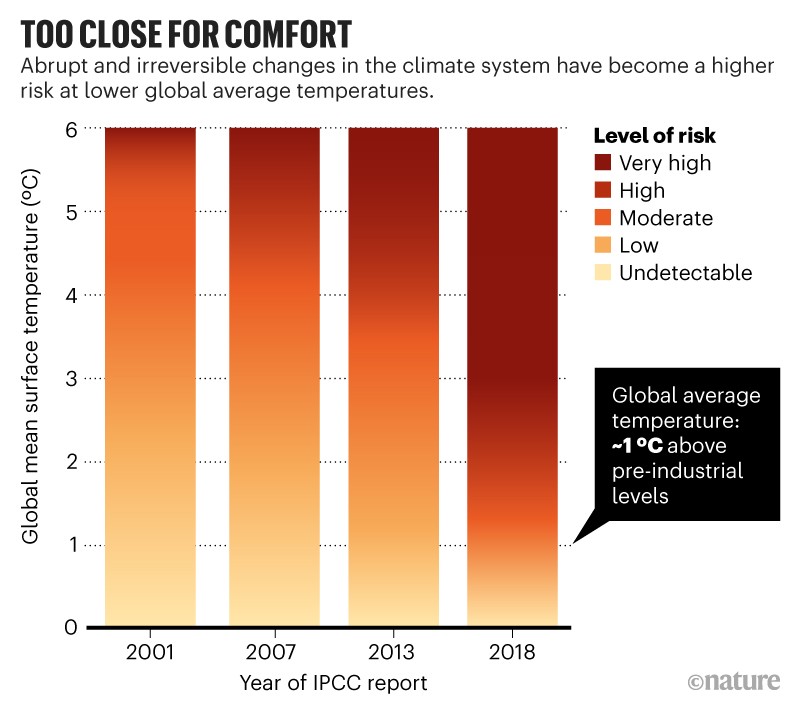
The Intergovernmental Panel on
Climate Change (IPCC) introduced the idea of tipping points two decades
ago. At that time, these ‘large-scale discontinuities’ in the climate
system were considered likely only if global warming exceeded 5 °C above
pre-industrial levels. Information summarized in the two most recent
IPCC Special Reports (published in 2018 and in September this year)2,3 suggests that tipping points could be exceeded even between 1 and 2 °C of warming (see ‘Too close for comfort’).
If current national pledges to reduce greenhouse-gas
emissions are implemented — and that’s a big ‘if’ — they are likely to
result in at least 3 °C of global warming. This is despite the goal of
the 2015 Paris agreement to limit warming to well below 2 °C. Some
economists, assuming that climate tipping points are of very low
probability (even if they would be catastrophic), have suggested that
3 °C warming is optimal from a cost–benefit perspective. However, if
tipping points are looking more likely, then the ‘optimal policy’
recommendation of simple cost–benefit climate-economy models4 aligns with those of the recent IPCC report2. In other words, warming must be limited to 1.5 °C. This requires an emergency response.
Ice collapse
We think that several cryosphere tipping
points are dangerously close, but mitigating greenhouse-gas emissions
could still slow down the inevitable accumulation of impacts and help us
to adapt.
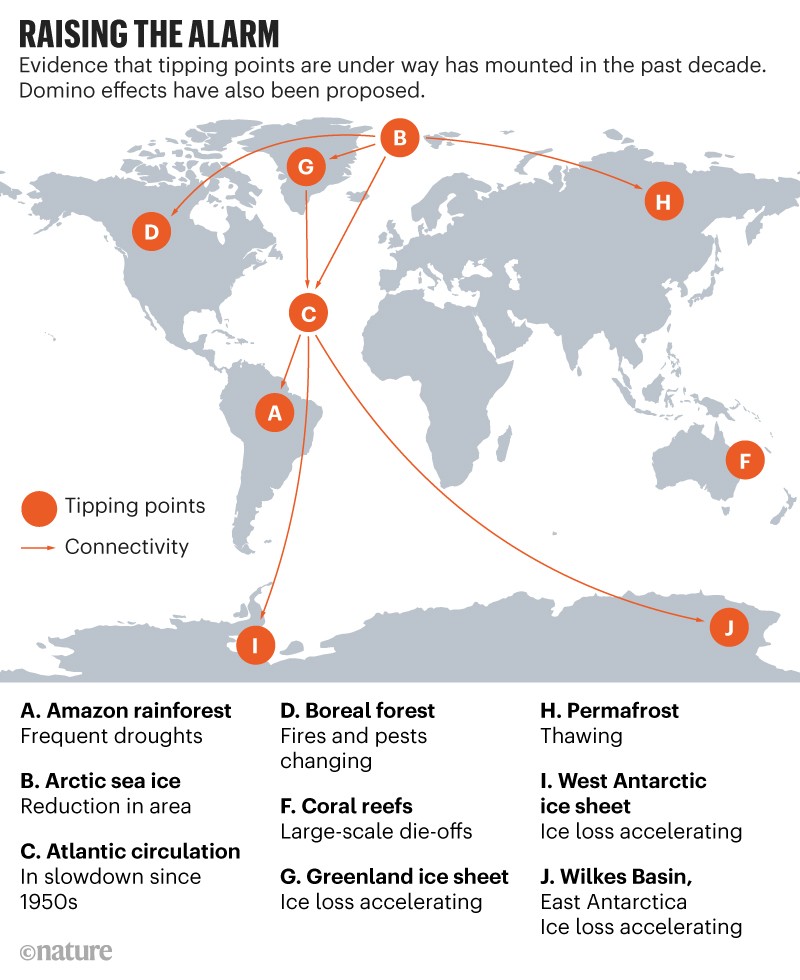
Research in the past decade has shown that the Amundsen Sea embayment of West Antarctica might have passed a tipping point3: the ‘grounding line’ where ice, ocean and bedrock meet is retreating irreversibly. A model study shows5
that when this sector collapses, it could destabilize the rest of the
West Antarctic ice sheet like toppling dominoes — leading to about 3
metres of sea-level rise on a timescale of centuries to millennia.
Palaeo-evidence shows that such widespread collapse of the West
Antarctic ice sheet has occurred repeatedly in the past.
The latest data show that part of the East Antarctic ice sheet — the Wilkes Basin — might be similarly unstable3. Modelling work suggests that it could add another 3–4 m to sea level on timescales beyond a century.
The Greenland ice sheet is melting at an accelerating rate3.
It could add a further 7 m to sea level over thousands of years if it
passes a particular threshold. Beyond that, as the elevation of the ice
sheet lowers, it melts further, exposing the surface to ever-warmer air.
Models suggest that the Greenland ice sheet could be doomed at 1.5 °C
of warming3, which could happen as soon as 2030.
Thus, we might already have committed future generations to living with sea-level rises of around 10 m over thousands of years3.
But that timescale is still under our control. The rate of melting
depends on the magnitude of warming above the tipping point. At 1.5 °C,
it could take 10,000 years to unfold3; above 2 °C it could take less than 1,000 years6.
Researchers need more observational data to establish whether ice
sheets are reaching a tipping point, and require better models
constrained by past and present data to resolve how soon and how fast
the ice sheets could collapse.
Whatever those data show, action
must be taken to slow sea-level rise. This will aid adaptation,
including the eventual resettling of large, low-lying population
centres.
A further key impetus to limit warming to 1.5 °C is that
other tipping points could be triggered at low levels of global warming.
The latest IPCC models projected a cluster of abrupt shifts7
between 1.5 °C and 2 °C, several of which involve sea ice. This ice is
already shrinking rapidly in the Arctic, indicating that, at 2 °C of
warming, the region has a 10–35% chance3 of becoming largely ice-free in summer.
Biosphere boundaries
Climate
change and other human activities risk triggering biosphere tipping
points across a range of ecosystems and scales (see ‘Raising the
alarm’).
Ocean heatwaves have led to mass coral bleaching and to the loss of
half of the shallow-water corals on Australia’s Great Barrier Reef. A
staggering 99% of tropical corals are projected2
to be lost if global average temperature rises by 2 °C, owing to
interactions between warming, ocean acidification and pollution. This
would represent a profound loss of marine biodiversity and human
livelihoods.
As well as undermining our life-support system,
biosphere tipping points can trigger abrupt carbon release back to the
atmosphere. This can amplify climate change and reduce remaining
emission budgets.
Deforestation and climate change are
destabilizing the Amazon — the world’s largest rainforest, which is home
to one in ten known species. Estimates of where an Amazon tipping point
could lie range from 40% deforestation to just 20% forest-cover loss8.
About 17% has been lost since 1970. The rate of deforestation varies
with changes in policy. Finding the tipping point requires models that
include deforestation and climate change as interacting drivers, and
that incorporate fire and climate feedbacks as interacting tipping
mechanisms across scales.
With the Arctic warming at least twice
as quickly as the global average, the boreal forest in the subarctic is
increasingly vulnerable. Already, warming has triggered large-scale
insect disturbances and an increase in fires that have led to dieback of
North American boreal forests, potentially turning some regions from a
carbon sink to a carbon source9.
Permafrost across the Arctic is beginning to irreversibly thaw and
release carbon dioxide and methane — a greenhouse gas that is around 30
times more potent than CO2 over a 100-year period.
Researchers
need to improve their understanding of these observed changes in major
ecosystems, as well as where future tipping points might lie. Existing
carbon stores and potential releases of CO2 and methane need better quantification.
The
world’s remaining emissions budget for a 50:50 chance of staying within
1.5 °C of warming is only about 500 gigatonnes (Gt) of CO2. Permafrost emissions could take an estimated 20% (100 Gt CO2) off this budget10,
and that’s without including methane from deep permafrost or undersea
hydrates. If forests are close to tipping points, Amazon dieback could
release another 90 Gt CO2 and boreal forests a further 110 Gt CO211. With global total CO2 emissions still at more than 40 Gt per year, the remaining budget could be all but erased already.
Global cascade
In our view, the clearest emergency
would be if we were approaching a global cascade of tipping points that
led to a new, less habitable, ‘hothouse’ climate state11.
Interactions could happen through ocean and atmospheric circulation or
through feedbacks that increase greenhouse-gas levels and global
temperature. Alternatively, strong cloud feedbacks could cause a global
tipping point12,13.
We argue that cascading effects might be common. Research last year14
analysed 30 types of regime shift spanning physical climate and
ecological systems, from collapse of the West Antarctic ice sheet to a
switch from rainforest to savanna. This indicated that exceeding tipping
points in one system can increase the risk of crossing them in others.
Such links were found for 45% of possible interactions14.
In
our view, examples are starting to be observed. For example, Arctic
sea-ice loss is amplifying regional warming, and Arctic warming and
Greenland melting are driving an influx of fresh water into the North
Atlantic. This could have contributed to a 15% slowdown15
since the mid-twentieth century of the Atlantic Meridional Overturning
Circulation (AMOC) , a key part of global heat and salt transport by the
ocean3.
Rapid melting of the Greenland ice sheet and further slowdown of the
AMOC could destabilize the West African monsoon, triggering drought in
Africa’s Sahel region. A slowdown in the AMOC could also dry the Amazon,
disrupt the East Asian monsoon and cause heat to build up in the
Southern Ocean, which could accelerate Antarctic ice loss.
The
palaeo-record shows global tipping, such as the entry into ice-age
cycles 2.6 million years ago and their switch in amplitude and frequency
around one million years ago, which models are only just capable of
simulating. Regional tipping occurred repeatedly within and at the end
of the last ice age, between 80,000 and 10,000 years ago (the
Dansgaard–Oeschger and Heinrich events). Although this is not directly
applicable to the present interglacial period, it highlights that the
Earth system has been unstable across multiple timescales before, under
relatively weak forcing caused by changes in Earth’s orbit. Now we are
strongly forcing the system, with atmospheric CO2
concentration and global temperature increasing at rates that are an
order of magnitude higher than those during the most recent
deglaciation.
Atmospheric CO2 is already at levels last
seen around four million years ago, in the Pliocene epoch. It is
rapidly heading towards levels last seen some 50 million years ago — in
the Eocene — when temperatures were up to 14 °C higher than they were in
pre-industrial times. It is challenging for climate models to simulate
such past ‘hothouse’ Earth states. One possible explanation is that the
models have been missing a key tipping point: a cloud-resolving model
published this year suggests that the abrupt break-up of stratocumulus
cloud above about 1,200 parts per million of CO2 could have resulted in roughly 8 °C of global warming12.
Some
early results from the latest climate models — run for the IPCC’s sixth
assessment report, due in 2021 — indicate a much larger climate
sensitivity (defined as the temperature response to doubling of
atmospheric CO2) than in previous models. Many more results
are pending and further investigation is required, but to us, these
preliminary results hint that a global tipping point is possible.
To
address these issues, we need models that capture a richer suite of
couplings and feedbacks in the Earth system, and we need more data —
present and past — and better ways to use them. Improving the ability of
models to capture known past abrupt climate changes and ‘hothouse’
climate states should increase confidence in their ability to forecast
these.
Some scientists counter that the possibility of global
tipping remains highly speculative. It is our position that, given its
huge impact and irreversible nature, any serious risk assessment must
consider the evidence, however limited our understanding might still be.
To err on the side of danger is not a responsible option.
If
damaging tipping cascades can occur and a global tipping point cannot be
ruled out, then this is an existential threat to civilization. No
amount of economic cost–benefit analysis is going to help us. We need to
change our approach to the climate problem.
Act now
In
our view, the evidence from tipping points alone suggests that we are
in a state of planetary emergency: both the risk and urgency of the
situation are acute (see ‘Emergency: do the maths’).
Emergency: do the maths
We define emergency (E) as the product of risk and urgency. Risk (R) is defined by insurers as probability (p) multiplied by damage (D). Urgency (U) is defined in emergency situations as reaction time to an alert (τ) divided by the intervention time left to avoid a bad outcome (T). Thus:
E = R × U = p × D × τ / T
The situation is an emergency if both risk and urgency are high. If reaction time is longer than the intervention time left (τ / T > 1), we have lost control.
We argue that the intervention time left to prevent tipping
could already have shrunk towards zero, whereas the reaction time to
achieve net zero emissions is 30 years at best. Hence we might already
have lost control of whether tipping happens. A saving grace is that the
rate at which damage accumulates from tipping — and hence the risk
posed — could still be under our control to some extent.
The stability and resilience of our planet is in peril. International action — not just words — must reflect this.
Nature 575, 592-595 (2019)
doi: 10.1038/d41586-019-03595-0
References
1.
Lenton, T. M. et al.Proc. Natl Acad. Sci. USA105, 1786–1793 (2008).