Thursday, July 24, 2025

A Reader’s Guide to the Big Beautiful Bill, Part 1 It’s not as hard as you think! Gabe Fleisher Jul 10, 2025

 https://www.wakeuptopolitics.com/p/a-readers-guide-to-the-big-beautiful

A Reader’s Guide to the Big Beautiful Bill, Part 1

It’s not as hard as you think!

Jul 10, 2025
 

Every time I write about a piece of legislation in this newsletter, I always make sure to include a link to the bill text, so you can read it for yourself if you want.

I’m not sure how many of you actually take me up on that.

Which is fair! The One Big Beautiful Bill Act, for example, which President Trump signed into law last week, is more than 150,000 words long. If you want to read roughly 150,000 words, you’ll probably settle down with The Scarlet Letter or The Grapes of Wrath (or approximately 100 issues of Wake Up To Politics), not a piece of budget legislation.

But the One Big Beautiful Bill Act — which, against my will, I will refer to as “OBBBA” for the rest of this newsletter — is important. It will likely cut your taxes. It might change federal benefits you receive. It will grow parts of your government and shrink others.

In a way, it’s also a crucial annual report written by employees of yours, in the sense that you were involved in hiring its authors last year and will be given the opportunity to say whether you want to renew or end their contracts next November. This is their way of telling you the biggest things they’ve accomplished since their hiring.

So before you make a decision about their employment, you should know what’s in it.

Of course, there’s no shortage of pieces out there summarizing the package. (I should know: I’ve written a few of them). But, as far as I can tell, there’s no available guide that really tries to walk people through reading the whole thing — piece by piece — instead of just focusing on all the flashiest parts or all the oddities.

And that’s why I set out to write one, with three goals:

  1. To help you understand (hopefully in an accessible and somewhat engaging way) the specifics of everything the OBBBA does, beyond just the vague sense you might get (from Republicans) that “we cuts your taxes!” or (from Democrats) that “they cut your Medicaid!”

  2. To help you learn more about your government. As you’ll see below, the U.S. government has its hands in so many areas of American life. We all know about Medicaid and Social Security. But how about the Sheep Production and Marketing Grant Program? The bill, in its own way, offers a fascinating tour through some of the lesser-known arms of the American government, and reading it is a cool way to learn about all the things you never knew your tax dollars were going to.

  3. To help you learn how to read an act of Congress, so maybe the next time a bill is linked in WUTP, it won’t seem so intimidating.

Reading legislation really isn’t as hard as you think! You’ll see: we’ll do it together.

That said, the bill is long. So I’ll be doing this in multiple parts. For ease of organization, we’ll split it into titles (there are 10 in all, one for each committee that helped draft it) and try to get through a few titles each day, with a few days in between each installment.

Before we dive in: This is a new experiment! Let me know in the comments whether you found this helpful and how it could be improved. That will help me know how to make Part 2 better and whether you want to see “reader’s guides” like this for other bills.

Putting this together took a fair amount of research. I’m only able to spend my time immersing myself in projects like this because of support from paid subscribers. I thought about paywalling this series, but ultimately felt this was important information for everyone to have access to. If you want to help support this sort of work, click below to become a paid subscriber:


OK, let’s get reading. Here’s a download link if you want to follow along. We’ll start on Page 1 of 330.

Front Matter

The package starts out simple enough, with its title:

Note that the formal title is not the One Big Beautiful Act. As loyal readers will recall, Republicans used the reconciliation process to pass the package along party lines and, according to something called the Byrd Rule, everything in a reconciliation bill has to be related to the budget.

Even the title! That’s how Democrats succeeded in striking the GOP’s preferred title from the official text. (H.Con.Res. 14 is the budget resolution that acted as a blueprint for the package.) I will still call it the OBBBA in this newsletter, instead of “An act to provide for reconciliation pursuant to title II of H.Con.Res.14.” (Or “AATPFRPTT2OHCR14” for short!) Don’t tell the parliamentarian.

Next we have the table of contents, which is eight pages long, and tells us how the bill will be organized: by titles, and then (for some titles) by subtitle, and then by section. I’ll touch on every title and subtitle in these reader’s guides (there are 10 and 28, respectively), but not necessarily every section. I’ll sometimes quote the text directly (and give you a sense of how to read it in conjunction with other important texts), but usually will write in my own words — though always in order of how things are in the bill, to help those reading along at home.

Title I: Agriculture, Nutrition, and Forestry (pp. 9-40)

The Supplemental Nutrition Assistance Program (SNAP), formerly known as food stamps, is a program that helps low-income Americans buy groceries. The program was also originally designed as a way for the government to help support farmers, by increasing demand for their products, which is part of why it’s administered by the Agriculture Department and falls under this title.

Food stamp benefits are allotted according to the Thrifty Food Plan (TFP), which is the government’s estimate of how much money a “healthy, budget-conscious” family needs for groceries. The plan was traditionally increased by the Agriculture Department according to inflation, but in 2021, the Biden administration used that power to unilaterally implement a 21% increase, the largest in history. (Vox called it the administration’s “biggest achievement” that “almost no one has heard about.”)

The OBBBA keeps the Biden-era change in place (at least for now), but prevents any future administration from adjusting the TFP amounts except to keep pace with inflation.

SNAP benefits already come with 20-hour-a-week work requirements, but the OBBA would shrink the pool of people exempt from those requirements. This is a good moment to dip into the text of the bill itself, which we’ll do occasionally, in order to show on a granular level how acts of Congress go about changing public policy. This is from Page 10:

Most bills don’t write law. They amend them. So, in this case, to understand what the provision is actually changing, we have to go to Title 7, Section 2015, Subsection (o), Paragraph 3 of the U.S. Code, where the existing SNAP statute lays out who is exempt from work requirements (which are laid out in Paragraph 2):

If we do that, we see that the work requirements currently lapse at age 55, so the OBBA moving the maximum to 65 puts anyone 55-64 newly under their reach. We also see that veterans, homeless people, parents of dependents older than 14, and former foster care youth older than 18 but younger than 24 have been removed from the list of exempted groups, while Native Americans have been added.

That’s the kind of side-by-side comparison you have to constantly be doing, to look at the old law and understand what’s different about the new law. Usually I’ll let you do that on your own if you want, but at a few points, we’ll do it together.

The bill goes on to empower the Agriculture Secretary to waive the work requirements for a state that is “noncontiguous…and has an unemployment rate that is at or above 1.5 times the national unemployment rate.” (This is one of several parts of the bill that were added to appeal to Sen. Lisa Murkowski, a key swing vote, although currently neither her home state of Alaska nor Hawaii has low enough unemployment to meet this standard.)

SNAP benefits are awarded based on income. The old law allows recipients to not count energy assistance they receive from a state government towards their income. The OBBA will only allow that for households “with an elderly or disabled member.” Recipients can also deduct their utility expenses from their income, but the OBBA will clarify that that deduction does not include the cost of internet service.

Currently, the federal government pays 100% of the cost of food stamps. (They split the administrative costs with states, which distribute the benefits.) The OBBA will change that, under a “Quality Control” scheme that correlates with a state’s payment error rate (how often states are under- or over-paying recipients). States with error rates under 6% won’t be on the hook for any benefit costs, states with error rates between 6-8% will have to pay for 5% of the costs, states with error rates between 8-10% will have to pay 10%, and states with error above above 10% will have to pay 15% of costs.

But here’s the catch. Under a section titled “Delayed implementation,” the OBBA also says that states with especially high error rates won’t have to start the cost sharing until Fiscal Years 2029 or 2030, instead of FY 2028 like everyone else (meaning, for at least a year or two, states with lower error rates will be paying more than states with higher error rates, incentivizing states to keep the error rates high for the time being). This goes back to Murkowski too: Alaska is the state with the highest SNAP error rate (originally, this carve-out was going to apply only to her state, but the parliamentarian made Republicans broaden it).

Starting in FY 2027, all states will also be on the hook for 75% of administrative costs, instead of the current 50%.

The OBBA also ends a nutrition education and obesity prevention grant program that has been part of SNAP since 1992. Finally, the package prevents SNAP benefits from going to almost anyone who isn’t a citizen or green cold holder. Already, immigrants here illegally are disqualified from benefits, but the OBBA would exclude most refugees, who currently do receive SNAP benefits. However, the package does specifically allow Cuban and Haitian refugees to keep their benefits.

Here’s all we’ve got in this subtitle:

“Public Law 117–169” is the Inflation Reduction Act, the Democratic reconciliation package from 2022, so this subtitle is clawing back certain funds from that bill that haven’t yet been spent. (Live by reconciliation, die by reconciliation.)

If you go to the sections of the IRA in question, you see’ll see that the rescinded funds mostly have to do with forest conservation and climate mitigation.

Usually, every five or six years, Congress passes a big bipartisan package known as a “farm bill” that reauthorizes all sorts of agriculture programs and subsidies for farmers. The last one passed in 2018 and expired in 2023; in a symbol of congressional dysfunction, instead of writing a new one, lawmakers have now extended the old one twice, with the latest extension going until the end of FY 2025.

Perhaps fearing that the two parties wouldn’t be able to agree on a new one before then, Republicans included a bunch of provisions in the next few subtitles that would normally go in a farm bill.

That includes adjustments to the reference prices that the government uses to subsidize farmers who produce key commodities like corn and wheat (when the market price drops below the reference price, the government pays the farmers a certain amount). Farmers qualify for these payments based on their number of “base acres” (acres historically used to farm the key commodities); the OBBBA would allow 30 million new base acres to be claimed.

The bill also updates and extends other farm assistance programs that were set to expire and sets new rates for farm loans. If you want to know the new for grain sorghum or the new loan for the large chickpea, this subtitle is for you.

This subtitle expands the Livestock Indemnity Program, the Livestock Forage Disaster Program, the Tree Assistance Program, and Emergency Assistance for Livestock, Honeybees, and Farm-Raised Fish, doing things like setting a normal mortality rate for honeybee colony losses (15%) and creating an aid category for farmers facing losses due to attacks on their farms by “piscivorous birds.”

Piscivorous birds are birds that eat fish. You learn something new every day.

The government also gives crop insurance benefits to beginning farmers and ranchers in their first five years of starting out. The OBBA increases the benefits, and offer them to farmers and ranchers in their first 10 years.

Among other changes, this subtitle also creates a Poultry Insurance Pilot Program, to insure poultry growers from “extreme weather-related risk resulting in increased utility cost.”

Here we’ve got funding for all sorts of agriculture programs, including the Environmental Quality Incentives Program, the Grassroots Source Water Protection Program, and the Feral Swine Eradication and Control Pilot Program. (Feral swines, beware!)

The Emergency Food Assistance Program, which purchases food to go to local food banks and soup kitchens, was also extended through 2031. A bunch of other programs were also extended, from the Emergency Citrus Disease Research and Development Trust Fund to the Sheep Production and Marketing Grant Program.

A program to boost agriculture trade was created, and more scholarships were authored for 1890 Institutions, which are historically Black colleges and universities that offer agriculture education.

Congrats, we made it through our first title! 40 pages down!

Title II: Armed Services (pp. 41-54)

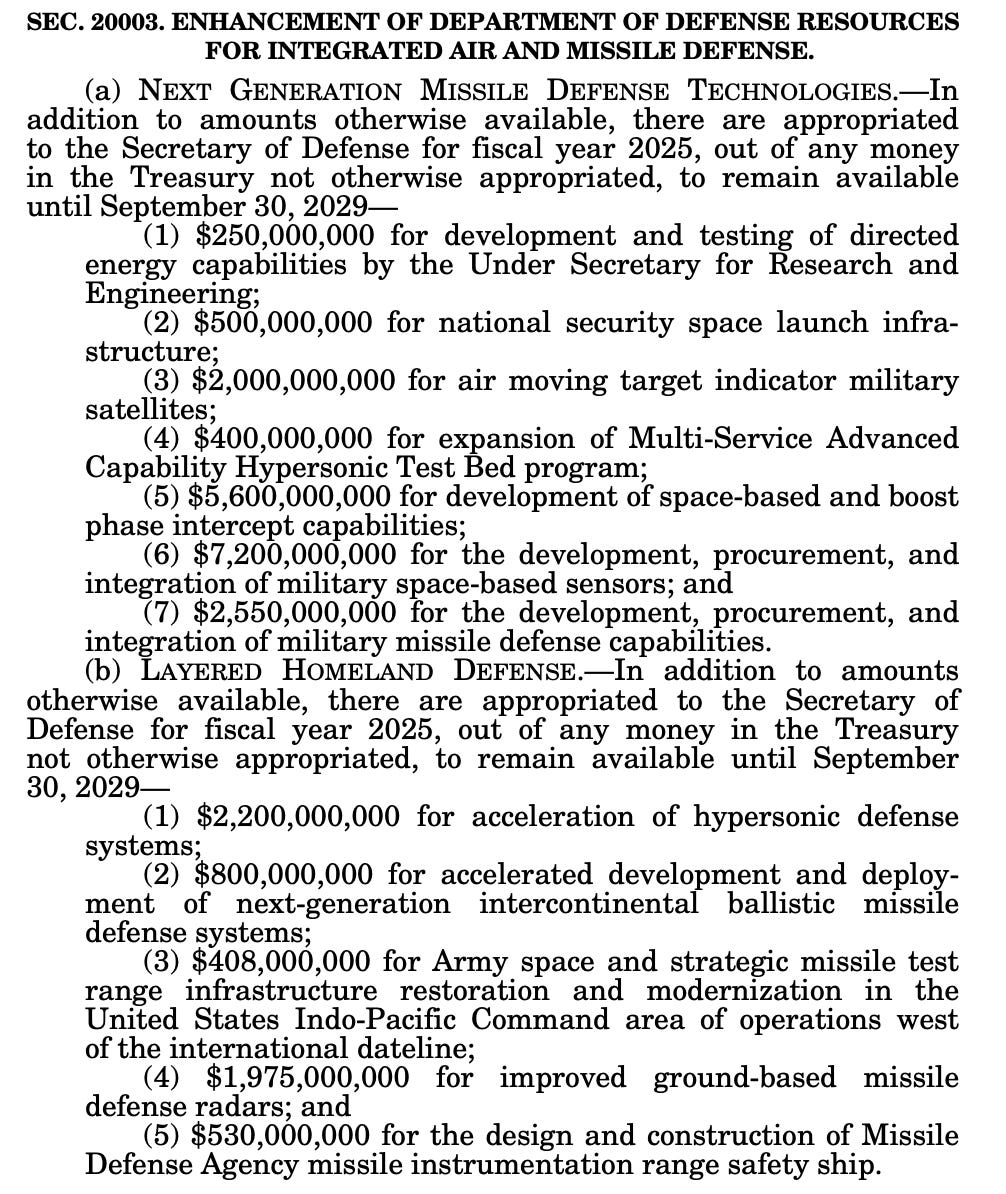
This title isn’t split into subtitles, but it’s much shorter and everything is pretty straightforward. There are no cuts, just a bunch of new money appropriated to the Defense Department. ($157 billion in all.)

One notable thing here is $25 billion set aside for Trump’s proposed Golden Dome missile defense system. It’s not called that in the text, though. Here’s how it describes itself, on page 44:
On Page 54, you also see $1 billion appropriated for the Defense Department to play a role in border operations:

I won’t walk through everything funded by this title, but these are the pages to look at if you’re curious about how the Pentagon is spending its new funds. Here are a few other line items from the title that caught my eye…

Several categories of AI funding, including:

More child care assistance for troops:

Money for 5G and 6G systems for the military:

Remember the Chinese spy balloon? Yes, we do the same thing:

And funding to purchase B-21 bombers, which are the next-generation aircraft set to replace the B-2 stealth bombers that were used to drop the “bunker buster” bombs used against Iran last month:


I could go all day — isn’t this fun?!? — but, out of respect for your time, we’ll call it there for our first installment.

We’ll pick up with Title III (Banking, Housing, and Urban Affairs!) soon. In the meantime, let me know what you think of this new experiment in the comments. And, as always, send any questions or things you’re curious about.

Thanks for embarking on this reading journey with me! See you next time.

I’m a War Scholar. There Is No Genocide in Gaza. John Spencer is chair of urban warfare studies at the Modern War Institute and host of the Urban Warfare Project Podcast. He served twenty-five years as an infantry soldier, which included two combat tours in Iraq.


https://x.com/SpencerGuard/status/1948010761957052628

I’m a War Scholar. There Is No Genocide in Gaza

In his New York Times op-ed titled “,” Omer Bartov accused Israel of committing genocide in Gaza. As a professor of genocide studies, he should know better. Genocide is not defined by a few comments taken out of context, by estimates of casualties or destruction, or by how war looks in headlines or on social media. It is defined by specific intent to destroy a national, ethnic, racial, or religious group in whole or in part. That is a high legal bar. Bartov did not meet it. He did not even try.
 
I am not a lawyer or a political activist. I am a war expert. I have led soldiers in combat. I have trained military units in urban warfare for decades and studied and taught military history, strategy, and the laws of war for years. Since October 7, I have been to Gaza four times embedded with the Israel Defense Forces. I have interviewed the Prime Minister of Israel, the Defense Minister, the IDF Chief of Staff, Southern Command leadership, and dozens of commanders and soldiers on the front lines. I have reviewed their orders, watched their targeting process, and seen soldiers take real risks to avoid harming civilians. Nothing I have seen or studied resembles genocide or genocidal intent.
 
Bartov claims that five statements by Israeli leaders prove genocidal intent. He begins with Prime Minister Netanyahu’s comment on October 7 that Hamas would “pay a huge price.” That is not a call for genocide. It is what any leader would say after the worst terrorist attack in the nation’s history. He also cites Netanyahu’s statements that Hamas would be destroyed and that civilians should evacuate combat zones. That is not evidence of a desire to destroy a people. It is what professional militaries do when fighting an enemy that hides among civilians.
 
Bartov presents Netanyahu’s reference to “remember Amalek” as a smoking gun. But this is a phrase from Jewish history and tradition. It is engraved at Israel’s Holocaust memorial, Yad Vashem, and also appears on the Holocaust memorial in The Hague. In both places, it serves as a warning to remain vigilant against threats, not as a call for mass killing.
 
He also highlights Defense Minister Gallant’s use of the term “human animals” to describe Hamas fighters. That is not a war crime. After the slaughter, rape, and kidnapping of civilians on October 7, many would understand or even share that reaction.
 
Unable to find intent among those actually directing the war, Bartov turns to far-right politicians like Bezalel Smotrich and Nissim Vaturi. These individuals do not command troops, issue orders, or shape battlefield decisions. I have studied the actual orders. They focus on destroying Hamas, rescuing hostages, and protecting civilians whenever possible. Their rhetoric is irrelevant to the legal case.
 
Israel has taken extraordinary steps to limit civilian harm. It warns before attacks using text messages, phone calls, leaflets, and broadcasts. It opens safe corridors and pauses operations so civilians can leave combat areas. It tracks civilian presence down to the building level. I have seen missions delayed or canceled because children were nearby. I have seen Israeli troops come under fire and still be ordered not to shoot back because civilians might be harmed.
 
Israel has delivered more humanitarian aid to Gaza than any military in history has provided to an enemy population during wartime. More than 94,000 trucks carrying over 1.8 million tons of aid have entered the territory. Israel has supported hospitals, repaired water pipelines, increased access to clean water, and enabled over 36,000 patients to leave Gaza for treatment abroad.
 
The IDF has coordinated millions of vaccine doses, supplied fuel for hospitals and infrastructure, and facilitated the flow of food and medicine through the UN, aid groups, and private partners. The U.S.–Israeli Gaza Humanitarian Foundation alone has delivered more than 82 million meals—one to two million a day—while weakening Hamas’s control over aid. This is not genocide. It is responsible and historic mid-war humanitarian policy.
 
Bartov cites death tolls from Hamas health authorities without question. He says 58,000 have been killed, including 17,000 children. But these numbers come from a terrorist organization. They mix civilians and fighters and count anyone under 18 as a child, even though Hamas uses teenagers and younger children as combatants. The figures are not independently verified and have been shown to contain false details, including names, ages, and sex. Civilian deaths are tragic, but in Gaza, they are also part of Hamas’s strategy.
 
No military operation is judged solely by body counts or destruction figures. If we used Bartov’s logic, every major war would be called genocide. Two million civilians died in the Korean War, an average of 54,000 per month. The Iraq and Afghanistan wars killed hundreds of thousands. The fight against ISIS leveled multiple cities and killed tens of thousands. None of those wars were considered genocidal. Gaza is not either. War is evaluated based on the actions of commanders, the goals set by leaders, and how well the military follows the laws of war, not by statistics taken out of context.
 
War is hell. It is inhumane, destructive, and ugly. But it is not automatically a crime. Nations must not target civilians. They must follow the rules of distinction, proportionality, and take all possible care to avoid civilian harm. Israel is doing that. I have seen it.
 
In Rafah this summer, Israel spent weeks preparing evacuations. It opened new safe areas and waited until civilians had moved before striking Hamas targets. That operation killed Hamas’s top commander, recovered hostages, and kept civilian deaths very low. It was a clear example of Israel’s extraordinary intent and actions to protect civilians while targeting only Hamas, a part of the story ignored by those who reduce war to headlines and numbers.
 
What is happening in Gaza is tragic. But it is not genocide. And it is not illegal.
 
Genocide requires clear, provable intent to destroy a people through sustained, deliberate actions. That burden of proof has not been met. Bartov and others have not even tried.
 
Likewise, the laws of war do not prohibit war itself. They require that military operations distinguish between combatants and noncombatants, that force be proportional to the objective, and that commanders take all feasible precautions to protect civilian life. I have watched the IDF do exactly that. I have seen restraint, humanitarian aid, and deliberate compliance with legal standards, often at tactical cost.
 
This is not a campaign of extermination. It is a war against Hamas, a terrorist army embedded in civilian areas by design.
 
The law matters. So does precision. And above all, truth matters.
 
John Spencer is chair of urban warfare studies at the Modern War Institute and host of the Urban Warfare Project Podcast. He served twenty-five years as an infantry soldier, which included two combat tours in Iraq. He is the coauthor of the book  .
You can also follow him on 'X' at:
The views expressed in this article are the writer's own.

Trump appointees have ties to companies that stand to benefit from privatizing weather forecasts

 https://apnews.com/article/trump-lutnick-weather-service-privatization-conflicts-9892de853c283468e6fb970cfd898d96


Trump appointees have ties to companies that stand to benefit from privatizing weather forecasts

By  BRIAN SLODYSKO and MICHAEL BIESECKER

WASHINGTON (AP) — As commerce secretary, Howard Lutnick oversees the U.S. government’s vast efforts to monitor and predict the weather.

The billionaire also ran a financial firm, which he recently left in the control of his adult sons, that stands to benefit if President Donald Trump’s administration follows through on a decade-long Republican effort to privatize government weather forecasting.

Deadly weekend flooding in central Texas has drawn a spotlight to budget cuts and staff reductions at the National Weather Service and the National Oceanic and Atmospheric Administration, two agencies housed within the Commerce Department that provide the public with free climate and weather data that can be crucial during natural disasters.

What’s drawn less attention is how the downsizing appears to be part of an effort to privatize the work of such agencies. In several instances, the companies poised to step into the void have deep ties to people tapped by Trump to run weather-related agencies.

Privatization would diminish a central role the federal government has played in weather forecasting since the 1800s, which experts say poses a particular harm for those facing financial strain who may not be able to afford commercial weather data.

The effort also reveals the difficulty that uber wealthy members of Trump’s Cabinet have in freeing themselves from conflicts, even if they have met the letter of federal ethics law.

“It’s the most insidious aspect of this: Are we really talking about making weather products available only to those who can afford it?” said Rick Spinrad, who served as NOAA administrator under President Joe Biden, a Democrat. “Basically turning the weather service into a subscription streaming service? As a taxpayer, I don’t want to be in the position of saying, ‘I get a better weather forecast because I’m willing to pay for it.’”

The White House referred requests for comment to the Commerce Department, which said in a statement that Lutnick has “fully complied with the terms of his ethics agreement with respect to divesture and recusals and will continue to do so.” 

Trump nominees have ties to weather-related industries

Privatizing weather agencies has long been an aim of Republicans. During Trump’s first presidency, he signed a bill that utilized more private weather data. And Project 2025, a proposed blueprint for Trump’s second presidency that was co-authored by his budget director, calls for the NOAA to be broken up and for the weather service to “fully commercialize its forecasting operations.”

Lutnick is not the only one Trump nominated for a key post with close relationships to companies involved in the gathering of vital weather data.

Trump’s pick to lead the NOAA, Neil Jacobs, was chief atmospheric scientist for Panasonic Weather Solutions and has been a vocal proponent of privatization. The president’s nominee for another top NOAA post, Taylor Jordan, is a lobbyist with a roster of weather-related clients.

“If confirmed, Dr. Jacobs and Mr. Jordan will follow the law and rely on the advice of the Department’s ethics counsel in addressing matters involving former clients,” the Commerce Department said in its statement. 

Elon Musk, the world’s richest man, who spent more than $250 million to help elect Trump, owns a controlling interest in SpaceX and its satellite subsidiary Starlink. Both are regulated by the NOAA’s Office of Space Commerce, which lost about one-third of its staff in February layoffs facilitated by the Department of Government Efficiency, which Musk helped create.

SpaceX also stands to gain through a new generation of private and federally funded weather satellites that would be carried into orbit on its rockets.

Though Musk has now departed Washington and had a very public falling out with Trump, the DOGE staffers he hired and the cuts he pushed for have largely remained in place.

Emails seeking comment sent to a lawyer who has represented Musk, as well as to media contacts at his companies X and SpaceX, received no response.

While Musk is focusing on his companies, others with potential conflicts remain immersed in government work.

Lutnick ran Cantor Fitzgerald

Lutnick resigned as CEO of Cantor Fitzgerald, an investing behemoth, upon taking office and began the arduous task of divesting his interests, as required by law.

His two 20-something sons were given the reins of his financial empire. Brandon Lutnick was named chairman of Cantor, while Kyle Lutnick was tapped to be executive vice chairman. But his most recent ethics filing from June 19 stated that he was still selling his holdings in the firm.

An ethics plan submitted in February states Lutnick would request a waiver allowing him to participate in matters that would have a “direct and predictable effect” on his family’s business while he was still divesting. Securities and Exchange Commission filings, meanwhile, show Lutnick has agreements to transfer his shares in the Cantor companies and a family trust to his son Brandon.

The Department of Commerce referred questions about Lutnick’s ties to Satellogic, a satellite company that offers natural disaster imagery, to his former firm.

Cantor spokesperson Erica Chase said that since Lutnick’s resignation from the company, he has not made any decisions with respect to the company’s investments or customer positions, or other operational matters.

“Cantor and its subsidiaries operate in heavily regulated industries, and maintain robust compliance programs to ensure compliance with all applicable laws,” Chase said.

Federal officials are barred from making decisions that benefit the business holdings of themselves or their spouses, but that prohibition does not extend to assets held by their adult children, according to Richard Painter, who served as the chief White House ethics lawyer during Republican George W. Bush’s administration.

Among its legion of disparate businesses, Cantor has interests in weather and climate. It owns a controlling interest in BGC Group, which operates a weather derivatives marketplace that essentially allows investors to bet on climate risk and where hurricanes will make landfall.

Lutnick also played a pivotal role in cultivating Satellogic. He helped raise the capital to take the company public and held a seat on its board until Trump nominated him. Cantor holds a roughly 13% stake in Satellogic, according to a March SEC filing.

The company now bills itself as an emerging federal contractor that can offer crisp images of natural disasters and weather events in real time, which in 2021 Lutnick said makes it “uniquely positioned to dominate the Earth Observation industry.”

While Lutnick was still in charge of Cantor, it paid a $6.75 million fine to the SEC after it was accused of making misleading statements to investors about Satellogic and another company. The White House’s 2026 spending plan, developed by Trump’s budget director and primary Project 2025 architect Russell Vought, proposes $8 billion in cuts for future NOAA satellites, which capture imagery of the planet provided to the public.

Satellogic stands to benefit if the government retreats from operating climate-monitoring satellites.

2 Trump nominees have ties to weather companies

Jacobs, Trump’s pick to lead the NOAA, led the same agency on an acting basis during Trump’s first term.

He is scheduled to appear Wednesday before a Senate committee weighing his nomination. Jacobs has long advocated for a greater role for the private sector in government weather forecasting. During a 2023 hearing focused on the future of the NOAA, he argued that the agency needed to be “relying more heavily on the commercial sector.”

He also has expressed concerns about what happens to commercial data purchased by the government. “They give it away to the rest of the planet for free,” he testified before Congress in 2023.

He was a consultant at the time for Spire Global and Lynker, both of which have millions of dollars in weather data contracts with the NOAA, according to records including his most recent financial disclosure.

Jordan, Trump’s pick for another top NOAA post, has similarly close relationships. His financial disclosure lists more than a dozen weather-related lobbying clients, including Spire and Lynker. He also represented AccuWeather, a commercial forecast provider, before Congress and in meetings with the Commerce Department on “issues related to private sector weather forecast improvement,” according to lobbying disclosures.

Though his nomination is pending before the Republican-controlled Senate, disclosure reports show he still represents weather and space companies and is still listed as a principal employee at a Washington lobbying firm.

___


The Trump Administration Is About to Incinerate 500 Tons of Emergency Food [theatlantic]

 https://www.theatlantic.com/health/archive/2025/07/usaid-emergency-food-incinerate-trump/683532/

The Trump Administration Is About to Incinerate 500 Tons of Emergency Food

Federal workers warned for months that the high-energy biscuits would go to waste.
By Hana Kiros


Five months into its unprecedented dismantling of foreign-aid programs, the Trump administration has given the order to incinerate food instead of sending it to people abroad who need it. Nearly 500 metric tons of emergency food—enough to feed about 1.5 million children for a week—are set to expire tomorrow, according to current and former government employees with direct knowledge of the rations. Within weeks, two of those sources told me, the food, meant for children in Afghanistan and Pakistan, will be ash. (The sources I spoke with for this story requested anonymity for fear of professional repercussions.)

Sometime near the end of the Biden administration, USAID spent about $800,000 on the high-energy biscuits, one current and one former employee at the agency told me. The biscuits, which cram in the nutritional needs of a child under 5, are a stopgap measure, often used in scenarios where people have lost their homes in a natural disaster or fled a war faster than aid groups could set up a kitchen to receive them. They were stored in a Dubai warehouse and intended to go to the children this year.

Since January, when the Trump administration issued an executive order that halted virtually all American foreign assistance, federal workers have sent the new political leaders of USAID repeated requests to ship the biscuits while they were useful, according to the two USAID employees. USAID bought the biscuits intending to have the World Food Programme distribute them, and under previous circumstances, career staff could have handed off the biscuits to the United Nations agency on their own. But since Elon Musk’s Department of Government Efficiency disbanded USAID and the State Department subsumed the agency, no money or aid items can move without the approval of the new heads of American foreign assistance, several current and former USAID employees told me. From January to mid-April, the responsibility rested with Pete Marocco, who worked across multiple agencies during the first Trump administration; then it passed to Jeremy Lewin, a law-school graduate in his 20s who was originally installed by DOGE and now has appointments at both USAID and State. Two of the USAID employees told me that staffers who sent the memos requesting approval to move the food never got a response and did not know whether Marocco or Lewin ever received them. (The State Department did not answer my questions about why the food was never distributed.)

In May, Secretary of State Marco Rubio told representatives on the House Appropriations Committee that he would ensure that food aid would reach its intended recipients before spoiling. But by then, the order to incinerate the biscuits (which I later reviewed) had already been sent. Rubio has insisted that the administration embraces America’s responsibility to continue saving foreign lives, including through food aid. But in April, according to NPR, the U.S. government eliminated all humanitarian aid to Afghanistan and Yemen, where, the State Department said at the time, providing food risks benefiting terrorists. (The State Department has offered no similar justification for pulling aid to Pakistan.) Even if the administration was unwilling to send the biscuits to the originally intended countries, other places—Sudan, say, where war is fueling the world’s worst famine in decades—could have benefited. Instead, the biscuits in the Dubai warehouse continue to approach their expiration date, after which their vitamin and fat content will begin to deteriorate rapidly. At this point, United Arab Emirates policy prevents the biscuits from even being repurposed as animal feed.

Over the coming weeks, the food will be destroyed at a cost of $130,000 to American taxpayers (on top of the $800,000 used to purchase the biscuits), according to current and former federal aid workers I spoke with. One current USAID staffer told me he’d never seen anywhere near this many biscuits trashed over his decades working in American foreign aid. Sometimes food isn’t stored properly in warehouses, or a flood or a terrorist group complicates deliveries; that might result in, at most, a few dozen tons of fortified foods being lost in a given year. But several of the aid workers I spoke with reiterated that they have never before seen the U.S. government simply give up on food that could have been put to good use.

The emergency biscuits slated for destruction represent only a small fraction of America’s typical annual investment in food aid. In fiscal year 2023, USAID purchased more than 1 million metric tons of food from U.S. producers. But the collapse of American foreign aid raises the stakes of every loss. Typically, the biscuits are the first thing that World Food Programme workers hand to Afghan families who are being forced out of Pakistan and back to their home country, which has been plagued by severe child malnutrition for years. Now the WFP can support only one of every 10 Afghans who are in urgent need of food assistance. The WFP projects that, globally, 58 million people are at risk for extreme hunger or starvation because this year, it lacks the money to feed them. Based on calculations from one of the current USAID employees I spoke with, the food marked for destruction could have met the nutritional needs of every child facing acute food insecurity in Gaza for a week.

Despite the administration’s repeated promises to continue food aid, and Rubio’s testimony that he would not allow existing food to go to waste, even more food could soon expire. Hundreds of thousands of boxes of emergency food pastes, also already purchased, are currently collecting dust in American warehouses. According to USAID inventory lists from January, more than 60,000 metric tons of food—much of it grown in America, and all already purchased by the U.S. government—were then sitting in warehouses across the world. That included 36,000 pounds of peas, oil, and cereal, which were stored in Djibouti and intended for distribution in Sudan and other countries in the Horn of Africa. A former senior official at USAID’s Bureau for Humanitarian Assistance told me that, by the time she’d left her job earlier this month, very little of the food seemed to have moved; one of the current USAID employees I spoke with confirmed her impression, though he noted that, in recent weeks, small shipments have begun leaving the Djibouti warehouse.

Such operations are more difficult for USAID to manage today than they were last year because many of the humanitarian workers and supply-chain experts who once coordinated the movement of American-grown food to hungry people around the world no longer have their jobs. Last month, the CEOs of the two American companies that make another kind of emergency food for malnourished children both told The New York Times that the government seemed unsure of how to ship the food it had already purchased. Nor, they told me, have they received any new orders. (A State Department spokesperson told me that the department had recently approved additional purchases, but both CEOs told me they have yet to receive the orders. The State Department has not responded to further questions about these purchases.) But even if the Trump administration decides tomorrow to buy more food aid—or simply distribute what the government already owns while the food is still useful—it may no longer have the capacity to make sure anyone receives it.

Friday, July 11, 2025

Hegseth To Try To Remove Females From Combat Rolls.....[theatlantic]. He Considers Females "The Lowest Common Denominator".

 https://www.theatlantic.com/national-security/archive/2025/07/pete-hegseth-women-combat-troops/683454/

Will Pete Hegseth’s ‘War on Woke’ Sideline Women?

Donald Trump’s Pentagon chief moderated his stance to get the job but is now pushing for change in the name of high standards.
By Missy Ryan
 
In 12 and a half minutes or less, you must: Run half a mile; scramble up a six-foot wall; lift 16 sandbags, each one roughly the weight of a 6-year-old child; drag a stretcher 100 meters; complete a farmer’s carry with a pair of 40-pound water cans; then run another half mile. Quickly take a breath. Then run four eight-minute miles and finish off with six chin-ups. That’s just day one at Ranger School, the arduous 62-day Army leadership course that washes out half of those who try.
Since the military opened ground-combat units to women, in 2016, 160 have earned their Ranger tabs. And in the vision that Pete Hegseth laid out days before being tapped as defense secretary last year, none of them belong on the front lines.
“I’m straight up just saying we should not have women in combat roles,” the Fox News host told a podcaster in November. “It hasn’t made us more effective, hasn’t made us more lethal, has made fighting more complicated.”
But to win confirmation as America’s 29th defense secretary, Hegseth needed votes from senators, one of whom, in particular, was a woman who had served in combat. Republican Senator Joni Ernst, who commanded troops in Iraq and Kuwait, remained a holdout. With his future riding on her vote, the nominee suggested under oath that his views had evolved. It wasn’t that he was against women in combat, per se. It was just that he wanted to uphold military excellence.
“Yes, women will have access to ground-combat roles, given the standards remain high,” Hegseth assured the senator at his confirmation hearing. Who could argue with high standards? Ernst voted yes and, with a tie-breaking vote from Vice President J. D. Vance, Hegseth’s nomination squeaked by, 51–50.
Six months into his tenure at the Pentagon, the secretary has not announced any plans to reverse the Obama administration’s 2013 decision to open all combat roles to women. But he is moving ahead with an effort to review and potentially overhaul combat and physical-fitness standards. Some view the push as a backdoor attempt to achieve the same goal.
This spring, Hegseth dispatched a newly created team of advisers to elite units and military schools—including bases where Special Forces, Navy SEALs, and Rangers are trained—looking for evidence of lowered standards. According to internal documents I obtained, members of the Secretary of Defense Assessment Team, which is headed by Hegseth’s adviser Eric Geressy, conducted the visits with a goal to “review and restore training standards” for elite units. In a previously unreported move, the documents also indicate a plan to “conduct a new review on Women in Combat (training/warfighting) Study.”
“We do not have the luxury to lower the standards in order to accommodate the lowest common denominator,” the document states. “Service members want a challenge they do not want to be part of a loosing [sic] team and want to serve alongside the best.”
During their visits to the John F. Kennedy Special Warfare Center and School at Fort Bragg, North Carolina; Ranger School at Fort Benning, Georgia; and the Naval Special Warfare Center in Coronado, California, members of Hegseth’s assessment team requested detailed information about performance, including raw data on individual candidates.
Hegseth’s suspicion that standards are slipping defies what military officials have told me again and again in recent months: that although all troops must take regular physical-fitness tests specific to their military service, most of which are adjusted for age and gender, they must also undergo separate, so-called occupational tests that are gender-neutral. For combat units, those include intense physical requirements far more strenuous than what other troops must do. An infantry soldier is going to have to sweat more than an accountant. Those job-related standards, the officials have told me, have not been lowered to accommodate women.
“There are myths that have been propagated, and what he’s doing is ginning up that myth again,” one person familiar with Hegseth’s review told me.
A quarter of the way into the 21st century, drones and digital weapons arguably matter more in warfare than push-ups and pull-ups. But in a military styled after the proclivities of Donald Trump and Hegseth, any whiff of special treatment for women or people of color must be eradicated. And changing the physical-fitness standards might turn out to be a means to a more ambitious end, one that could alter the landscape for women in uniform and send a deterrent message to women wishing to join.
“They definitely have a solution in search of a problem,” said the person familiar with the review who, like others, spoke with me on the condition of anonymity. “He keeps looking for data to show that standards have been lowered, and that women can’t hack it.”
The only trouble? The person told me that “there is no data like that.”
Women make up roughly 20 percent of today’s military, but until recently, their roles were sharply limited. Women were not permitted to fly in combat aviation units until 1993 or serve on submarines until 2010. Although thousands of women served on the front lines in support roles in two decades of counterinsurgent warfare following 9/11, they remained officially barred from combat until the past decade.
In 2013, Barack Obama’s second defense secretary, Leon Panetta, announced that the ban on women serving in ground-combat roles would end in the coming years. “Not everyone is going to be able to be a combat soldier,” Panetta said at the time. “But everyone is entitled to a chance.”
In late 2015, after a divisive internal review, Ashton Carter, Obama’s fourth and final defense secretary, ordered the integration of some 200,000 ground-combat roles. Physical and other standards for those units would remain gender-neutral, Carter cautioned, and there would be no quotas for female participation. Of the military services, only the Marine Corps dissented, citing a study that found that mixed-gender Marine units did not perform as well as all-male units. (Carter and others cited flaws with the study, and the Marines were integrated along with the others.)
Since then, female officers have commanded armor and artillery platoons and moved into other ground-combat jobs. Roughly 500 female Marines currently serve in combat roles. Still, the share of women in ground-combat units remains tiny. Fewer than 10 women have passed the Army Special Operations Command’s demanding “Q Course” to become Special Forces soldiers, and no woman has become a Navy SEAL. Of the 1,400 soldiers who completed Ranger School last year, the overwhelming majority were men.
After his nomination, Hegseth was careful to praise women’s “indispendable role” in the military, as he told the podcaster Megyn Kelly in December. “The women of the Pentagon, of our military, are revered, appreciated,” he said. “All I’ve really ever cared about is making sure the standards are maintained.”
But Hegseth’s problem with women in ground-combat units wasn’t just operational; it was moral. In a book he published a few months earlier, Hegseth devotes a chapter to what he calls “the (deadly) obsession with women warriors.” Women can serve as pilots and support troops, and they may sometimes find themselves in the cross fire of the modern battlefield. But placing them in infantry or artillery units, Hegseth argues, causes problems. It distracts male soldiers from their core mission, forces them to compensate for female soldiers’ lesser strength and smaller body size, and makes casualties more likely. Spineless uniformed leaders, ceding to Democratic demands over the past decade, have watered down combat standards to accommodate women, he writes, leaving the military weaker. Thrusting women into jobs focused on killing would also disrupt traditional gender norms. “Dads push us to take risks. Moms put the training wheels on our bikes,” he writes. “We need moms. But not in the military, and especially not in combat roles.”
Hegseth compares what he sees as the unrealistic goal of willing women’s physical strength to match that of men’s with America’s failed attempts to impose democracy on Afghanistan. He rails against decisions made by the “so-called enlightened class” that would end up costing service member lives. “They don’t care how many battles we lose as long as our dead are diverse,” he writes.
In the weeks after he arrived at the Pentagon in January, Hegseth moved quickly to eliminate what he publicly derided as “woke bullshit,” in line with an executive order that Trump issued on Inauguration Day. Pentagon officials launched a chaotic effort to take down online content containing references to race or gender, removing webpages featuring the first female fighter pilot and Ranger graduate, along with others celebrating the Tuskegee Airmen and Jackie Robinson. The Pentagon reinstated a ban on transgender service members and suspended advisory boards on women in the services. In February, the president abruptly fired Admiral Lisa Franchetti, the first-ever female chief of naval operations, and General Charles Q. Brown Jr., the chairman of the Joint Chiefs of Staff, only the second Black officer to hold that job. Hegseth had attacked both officers in his book for being excessively focused on race or being diversity hires. Neither has commented publicly about their firing.
Hegseth has highlighted the progress the military has made in “reviving the warrior ethos” and eradicating Democratic administrations’ misplaced focus on diversity in the ranks. In Hegseth’s view, there was no racism or sexism problem to fix, so drawing attention to those issues just stirred up discord.
Speaking to Special Operations forces in May, Hegseth said that troops “want to be in disciplined formations that value them not for immutable differences, not for the color of our skin, or gender, but because of honor and integrity and grit and patriotism.” He added: “They want a meritocracy where they can work hard, make themselves better, kick ass and rise up.”
For Hegseth, physical fitness is a trait of the utmost importance. As he told soldiers at the Army War College in April, service members must be “fit, not fat; sharp, not shabby.” Pentagon social media has emphasized his morning physical-training sessions with the troops, doing push-ups from Warsaw to Omaha Beach. The secretary has vowed that standards will be “high, equal, and unwavering.”
In March, Hegseth announced a military-wide review of combat and physical-fitness standards, ordering Pentagon officials to develop plans to distinguish between combat and noncombat jobs and to ensure proper requirements for those roles, including “the ability to carry heavy loads” and exhibiting “speed, strength, agility, and endurance.” To that order, Hegseth added a handwritten addendum: “No existing standard will be lowered in this process.”
In a video released shortly afterward, Hegseth strides along the corridor outside his Pentagon office, speaking straight to the camera as he explains the initiative as a commonsense fix to the military’s failure to enact equal and adequate standards when it integrated women into combat roles.
Last month, in an echo of his earlier, pre-nomination statements, Hegseth posted on his personal X account a news article about Israel’s decision to end a trial program that placed women in combat positions, because of the difficulty they faced in meeting physical requirements. “Worthy [sic] paying attention to,” he wrote. “Israel takes standards & testing very seriously.”
But in those statements, Hegseth has repeatedly mischaracterized the status quo. Notably, Hegseth has not been able to identify evidence of lowered combat requirements in the U.S. military. Instead, the secretary and his supporters have pointed to standards being “informally” lowered, suggesting without evidence that women have been waved through Ranger School or given extra chances because of mandates or pressure from politically attuned bosses.
Spokespeople for Naval Special Warfare, which trains Navy SEALs; for Army Special Operations Command, which trains Special Forces soldiers; and for Fort Benning, where Ranger School is located, all said they have gender-neutral standards. “We ensure our data-[validated], operationally validated, and gender-neutral standards are building the warfighter for today and the future,” Lieutenant Colonel Allie Scott, a spokesperson for Army Special Operations, told me. Jennifer Gunn, a spokesperson at Fort Benning, told me that opportunities to repeat phases of the Ranger course, known as “recycling,” are based on performance. “No demographic or group is afforded preferential treatment,” she said.
One retired female officer who completed Ranger School told me that many men, like many women, who attempt to go into combat jobs are unable to meet the standards. But some from both genders will excel. “The thing that bothers me about the rhetoric about standards being lowered is that no one can exactly tell you what they mean. Was it pull-ups? Was it something else?” the female Ranger School graduate said. “It feels like a sound bite.”
Pentagon Press Secretary Kingsley Wilson, in a statement, said that combat-position standards would be “elite, uniform, and sex neutral, because the weight of a rucksack or a human being doesn’t care if you’re a man or a woman.”
Katherine Kuzminski, the director of studies at the Center for a New American Security, told me that that is already the case, at least in terms of occupational standards. She said Hegseth’s rhetoric may resonate because of the confusing nature of physical and occupational tests across services and military specialties. “When you look at the broader picture of Hegseth’s previous writings and comments, it sends a message that somehow women aren’t meeting the mark,” Kuzminski said. “In reality, the sex-neutral standards he lays out as his goal in the memo already exist in combat specialities."
Hegseth’s critics suspect he knows that but has other motives in mind.
“We need to make sure that there isn’t some sort of surreptitious effort ongoing to try to narrow the people who are allowed to serve,” Democratic Representative Chrissy Houlahan of Pennsylvania, an Air Force veteran, told me. “I think there is a kind of a lurking theory that the only kind of warrior is a 6-foot-4-inch male Christian guy from the South. But there is also, increasingly, a place for people who are also able to complement that—a warrior who is a thinker, or an engineer, or a number of other kinds of things.”
Houlahan and others caution that, despite the recent recruiting boost that Trump and Hegseth are touting, Americans’ propensity to serve has undergone a long decline, now hovering around 11 percent. America’s future military will need women to help fill the ranks.
Hegseth’s review poses a different challenge for the Navy and the Air Force than it does for the infantry-focused Army and Marine Corps. A fighter pilot most certainly is in combat, but his or her job has much different physical requirements than a Marine’s on the front lines. Serving as a cook on a big ship isn’t normally considered a combat job, but that sailor may be called to command the guns in the event of an attack. And what makes sense for Space Force service members who might sit at a computer all day operating a satellite?
The Navy has age- and gender-normed general physical-fitness standards and separate age- and gender-neutral fitness and occupational standards for six elite professions, including Navy divers, rescue swimmers, and technicians who, among other duties, neutralize underwater explosives. A bomb-disposal tech, for example, must do, in two minutes each, a minimum of six pull-ups and at least 50 push-ups and 50 curl-ups, plus a 500-yard swim and 1.5-mile run in fewer than 21 minutes.
The Air Force has a similar system: gender- and age-adjusted physical-fitness tests for the whole force and then heightened, age- and gender-neutral physical tests for a subset of jobs more similar to ground combat, including combat control and pararescue. Those individuals must perform tasks including carrying a 60-pound load three miles in under 49 minutes and deadlifting at least 270 pounds. “We don’t care how old you are. We do not care what sex you are,” one Air Force official said of those specialties. “Here is the bar. If you’re going to be in this career field, you must meet it.”
All Marines take two different age- and gender-normed fitness tests each year. In addition, Marines in ground-combat roles, regardless of gender, must take an additional job-specific physical test that is gender- and age-neutral. A Marine rifleman, male or female, must simulate evacuating a 205-pound casualty 50 meters, for example, and scaling a 56-inch wall, all while also carrying their 55-pound fighting load.
The Army has had perhaps the most winding, emotionally charged physical-fitness saga.
Last year, a Republican amendment to an annual defense bill mandated higher standards for combat jobs. To help determine what the new minimum standards for those jobs might be, the Army asked RAND to conduct a study that, among other things, showed a drop-off in pass rates for women and National Guard and Reserves soldiers when standards were raised past a certain level. Before Joe Biden left office, Army leaders decided to raise the standards for those combat jobs but keep them gender-normed.
The Army changed course after the Trump administration took over, opting for a gender-neutral standard for 21 combat specialties. An Army official told me that Trump’s new Army secretary, Daniel Driscoll, “was very much, ‘Let’s have high standards and whoever meets those standards, we’re good to go,’” the official said. But in a curious move that the Army has struggled to explain, it kept the test age-adjusted for those jobs, even though the argument for a sole standard had long been that combat doesn’t care who you are—your age, identity, or gender.
Another Army official said that the service’s leadership believed that aligning with Hegseth’s priorities would benefit the Army. “I don’t know how many push-ups you have to do to survive on the battlefield,” the official told me. “But I do know that more is better.”
Many female veterans support gender-neutral, job-related standards. “Women should be allowed to try and fail,” the female Ranger School graduate told me. “You should want people to go to Ranger School. If they fail, maybe they’ll go back and retrain.”
Samantha Weeks, a former fighter pilot who served as a member of a Pentagon advisory board on women until it was suspended, recalled having to bench 80 percent of her body weight when she was in pilot training in the late 1990s. It was hard, but achievable. “I think there is not a woman out there in the military who doesn’t want the standard to be the standard,” she told me.
But many current and former officials also say the military needs to do a better job in developing evidence-based physical criteria. “You just have to make sure the requirements are rational to the role and aren’t a vestige of a different era,” Alex Wagner, who served as the Air Force’s assistant secretary for personnel during the Biden administration, told me. “Pete Hegseth’s understanding of the military seems frozen in 1980s action films. But today’s battlefield isn’t going to be Rambo hacking his way through jungles.”
Pentagon officials say they have been informed that Hegseth’s office is preparing to release a new, military-wide physical-fitness test. It was not immediately clear whether that test, should it materialize, would replace the service tests or whether it would be gender-neutral. Any significantly higher standard could have the greatest impact on National Guard and Reserves troops, which typically do worse on fitness exams than active-duty personnel.
Weeks, the former fighter pilot, recalled being the only female pilot in her squadron when she flew long missions over Iraq as part of Operation Northern Watch in 2000. Unable to use the “piddle pack” that male pilots used to relieve themselves, and unwilling to opt for “tactical dehydration,” which could be dangerous during a 12-hour mission, she used a DIY solution involving a neonatal face mask and a surgical tube.
In the years since, women have expanded their presence across the force and, along the way, earned greater recognition that they may have different needs, but that doesn’t mean that they’re less capable of doing the job. This year, the Air Force rolled out a new alternative for the male piddle pack to make missions easier for female pilots.
“I had men who told me, ‘I don’t want to talk about that. Go find a female,’” Weeks recalled of trying to find support in her unit. “‘Well, what female can I talk to?’ I said. ‘There are no others.’”

About the Author

Missy Ryan is a staff writer at The Atlantic. She can be reached on Signal at mryan.86.