Saturday, December 3, 2022

Xi Jinping in His Own Words | What China’s Leader Wants [foreignaffairs.com]

https://www.foreignaffairs.com/china/xi-jinping-his-own-words

Xi depicts the current historical period as one of great risk and opportunity. It is his “historical mission” to exploit the inflection point and push history along its inexorable course through a process of “struggle,” which includes identifying internal and external enemies, isolating them, and mobilizing the party and its acolytes against them. 

Xi expanded on these ideas in an impassioned address to the Sixth Plenum meeting of Communist Party leaders in November 2021, lauding Mao’s 1950 decision to send “volunteers” across the Yalu River into Korea to fight the U.S. and UN forces commanded by U.S. General Douglas MacArthur. 

Comrade Mao Zedong, with the . . . strategic foresight of “by starting with one punch, one hundred punches will be avoided,” and the determination and bravery of “do not hesitate to ruin the country internally in order to build it anew,” made the historical policy decision to resist America and aid Korea and protect the nation, avoid the dangerous situation of invaders camping at the gates, and defend the security of New China. 

Xi’s speech made an equally strong endorsement of the CCP’s “decisive measures” to crush the student protests at Tiananmen Square in 1989 and withstand “the pressure of Western countries’ so-called sanctions” that followed. This saved the party, in Xi’s telling, and today “the CCP, the People’s Republic of China, and the Chinese nation have the most reason to be self-confident” of any “political party, country, or nation” in the world. The statements leave little doubt that Xi would be willing to adopt “decisive measures” again today if less violent means to disperse demonstrations failed.

Like many of Xi’s most aggressive and important statements, his Sixth Plenum speech was initially kept secret. It was delivered behind closed doors and published in Qiushi magazine nearly two months later. The CCP does not appear to have published an official English translation of it, and the speech was all but ignored by Western news outlets. 

But just over a year later, its implications have become clear: regardless of near-term economic considerations for China, Xi is being guided by ideology and his firmly held diagnosis that the West is declining and that Beijing, led forcefully by Xi himself, must take risks and act decisively to assert new spheres of influence and build a world conducive to Marxist autocracy.

MARXIST MEANS AND ENDS

Xi Jinping Thought makes clear that Marxism is not just the means to achieving global supremacy but also the goal of that supremacy. “Karl Marx dedicated his entire life to overthrowing the old world and establishing a new world,” Xi said in 2018 while presiding over Marx’s 200th birthday celebration in Beijing—an event surrounded by weeks of propaganda and publications timed to establish Xi as the designated heir to Marx, Lenin, Stalin, and Mao. Xi called the German theorist “the greatest thinker in human history” and decreed that “Marxism is not to be kept hidden in books. It was created in order to change the destiny of human history.”

This phrasing evoked a major foreign policy initiative that Xi has embraced called “A Community of Common Destiny for Mankind,” which aims to shape the global environment in ways favorable to Beijing’s authoritarian model. (The ominous-sounding term “common destiny” is often misleadingly translated by the CCP into the more anodyne English phrase “shared future.”) Xi’s 2018 speech made clear that the initiative and Marx’s vision of a stateless, collectivized world are linked. 

“Just like Marx, we must struggle for communism our entire lives,” Xi said. “A collectivized world is just there, over [the horizon]. Whoever rejects that world will be rejected by the world.” 

Ian Easton, an American researcher, discovered a recent set of People’s Liberation Army textbooks focused on Xi’s ideology that elaborate further on the link between Xi’s foreign policy and global communism. These books, edited by top educators and administrators at National Defense University and labeled as “internal teaching materials” for senior military officers, can be taken as authoritative. In China, the military is subordinate to the party, not to the state, and ideological training figures heavily in the education of officers. Xi has described the National Defense University as “an important base” for training China’s officer corps. 

Passages from the textbooks, cited in Easton’s 2022 book, The Final Struggle: Inside China’s Global Strategy, underscore the idea that overturning U.S. leadership around the globe is only one phase of Xi’s plan. Xi also seeks to upend the concept of equal and sovereign states that emerged from Europe four centuries ago and is the cornerstone of international relations, according to the texts. As one of them, Strategic Support for Achieving the Great Chinese Rejuvenation, explains:

The Westphalian System was founded on the notion of a balance of power. But it has proven unable to achieve a stable world order. All mankind needs a new order that surpasses and supplants the balance of power. Today, the age in which a few strong Western powers could work together to decide world affairs is already gone and will not come back. A new world order is now under construction that will surpass and supplant the Westphalian System. 

This and the other textbooks leave no doubt that the system that replaces the 1648 Treaties of Westphalia must be the socialist model made in China. “As we push for the fusion of the world’s civilizations on the basis of developing our nation’s unique civilization, there are several things that must be done,” reads one passage. “[We] must insist on taking the road of development with Chinese cultural characteristics. . . . And we must insist on our principles and our bottom line as we actively engage with others.”

Another passage states: “The Community of Common Destiny for Mankind will mold the interests of the Chinese people and those of the world’s people together.” At another point, that same text makes clear who has decreed this approach: “Xi Jinping has emphasized that our state’s ideology and social system are fundamentally incompatible with the West. Xi has said ‘This determines that our struggle and contest with Western countries is irreconcilable, so it will inevitably be long, complicated, and sometimes even very sharp.’” The textbook’s authors evidently took the term “very sharp” to mean violent. As the book continues: “To use war to protect our national interests is not in contradiction with peaceful development. Actually, such is a manifestation of Marxist strategy.”

In the meantime, the book advocates weaponizing economic dependence and greed: “We must gain a grip on foreign government leaders and their business elites by encouraging our companies to invest in their local economies.” 

STRUGGLE SESSION

Xi further codified this view of China’s mission at the party congress in October, as he adjusted official language to match his vision and made personnel changes to reflect his control of the CCP and the preeminence of his thinking. One way in which this was achieved was through an act of editing: Xi led the congress in unanimously voting to insert the word “struggle” into the Party Charter in several more places. These changes were missed by some foreign observers, perhaps because the CCP’s English-language propaganda selectively mistranslated the word “struggle,” using euphemisms such as “persistent hard work.” But the term now rivals references to “reform and opening” in the charter, signaling that Beijing’s focus will now be even more on confronting perceived enemies at home and abroad and less on growing the economy. 

The personnel changes at the top of the party suggest much the same. In a difficult-to-parse sequence of events during the proceedings, Xi’s elderly predecessor Hu Jintao was removed, seemingly against his will, from his seat next to Xi on a dais in the Great Hall of the People. That might have been passed off as clumsy choreography or perhaps as a response to some medical issue. But soon afterward, Xi dumped all three of Hu’s allies from the Politburo, replaced them with personal loyalists, and elevated military industrialists and security-apparatus officials in place of officials with national-level economic experience. These changes made Hu’s removal appear more like a public humiliation.

Xi’s picks to lead the military—the two vice chairs of the Central Military Commission, of which Xi himself is chair—further signal his disruptive geopolitical ambitions. Xi reappointed Zhang Youxia as first vice chair, despite Zhang’s advanced age (72), which put him well past typical retirement age. (Zhang’s father fought side by side with Xi’s in China’s civil war.)

For the second vice-chair seat, Xi selected He Weidong, a 65-year-old with a focus on joint operations and experience on China’s contested frontiers. He commanded ground forces in China’s west during a period of high tension (and some bloodshed) with India, then led the Taiwan-focused eastern theater, where he oversaw a dress rehearsal for war following U.S. House Speaker Nancy Pelosi’s visit to the island in August. But to become vice chair, he required a double promotion. 

In short, Xi’s new leadership team appears tailormade for “the spirit of struggle” and for the “high winds and waves” and “stormy seas of a major test” that he referred to in his work report to the Party Congress. One wonders whether he had Taiwan in mind when he chose those particular words.

WARMING UP TO “CONSTRAINMENT” 

In May, U.S. Secretary of State Antony Blinken gave a major address laying out the Biden administration’s China policy. “We are not looking for conflict or a new cold war,” Blinken asserted in his speech. “To the contrary, we’re determined to avoid both.”

The Biden administration avoids using the Cold War term “containment” to describe its approach to China, and Blinken did not use that term in his speech. But what he described echoes the successful approach Washington adopted in its contest with the Soviet Union. As one senior American official explained in a briefing to preview Blinken’s speech, U.S. policy is focused on “constraining Beijing’s ability to engage in coercive practices.” Washington seeks to work with allies to “leverage our collective strength” and “close off vulnerabilities that China is able to exploit.” Blinken summed it up in these terms in his address: “We cannot rely on Beijing to change its trajectory. So we will shape the strategic environment around Beijing to advance our vision for an open, inclusive international system.”

This is not quite containment, but it bears a family resemblance. “Constrainment” is the term that one of us (Pottinger) has used to describe it. A policy of constrainment, unlike containment, accounts for the current realities of economic interdependence and seeks to tilt them to Washington’s advantage. Constrainment should seek to puncture Beijing’s confidence that it can achieve its aims through war and sap Beijing’s optimism that it can decisively accumulate coercive economic leverage over the United States and other democracies.

Putin’s belief that western Europe had become too dependent on Russian energy to meaningfully oppose his armored assault on Kyiv appears to have been a significant factor in his decision to re-invade Ukraine. Xi is working to acquire similar coercive leverage—what he calls the “powerful countermeasure” of “international production chains’ dependence on China”—in semiconductor manufacturing and other high-tech inputs to the global economy. An allied constrainment policy would avoid falling into this trap, as well as extricate the United States where it has already stumbled into one. Washington and its allies must adopt, in essence, the opposite of Germany’s corporatist, antistrategic foreign policy that tethered European prosperity to the whims of adversarial “Führer states,” to borrow Wolfgang Ischinger and Sebastian Turner’s apt phrase. 

Rules regarding semiconductors that the Biden administration issued in October take an important step in the right direction. Beijing currently must import hundreds of billions of dollars’ worth of chips annually—a dependence that Washington should work to sustain. The most important elements of the new rules are limits on the export of chip-making equipment and U.S. skilled labor to China. If enforced diligently, the rules will foil Xi’s ambition to make China the world’s largest chipmaker and erode its goal of commanding the high-tech supply chains of its trade partners. 

That dynamic is the essence of constrainment, which should strive to maintain a favorable balance of dependence in a wide range of areas. A policy of constrainment should, for example, strengthen the dominance of the U.S. dollar as a global reserve and trading currency, extending Washington’s ability to monitor and punish money laundering, weapons proliferation, bribery, and other dangerous actions by Beijing. Constrainment should remind Beijing of its dependence on foreign sources of food and energy while reversing the United States’ growing reliance on Chinese batteries, solar panels, and other “green” technology. 

Constrainment would also rectify the lead Beijing has, incredibly, opened over the United States in global Internet governance and control of information and data flows. The fact that ByteDance, a Chinese company, controls TikTok—the fastest growing news and video content outlet in the United States—represents a potentially grave failure by Washington to protect democracy and free speech. TikTok’s algorithms, whose source code Beijing has restricted from being transferred out of China, could be modified to suppress or amplify content according to the CCP’s preferences, which would give China the ability to influence the views of tens of millions of Americans. Zhang Fuping, who serves as editor in chief of ByteDance, is also the secretary of the company’s Communist Party Committee, tasked with ensuring the company’s alignment with the CCP’s interests. According to a report in Sina Finance, at a meeting in 2018, Zhang declared that the company should “‘take the lead’ across ‘all product lines and business lines’ to ensure that the algorithm is informed by the ‘correct political direction’ and ‘values.’” And according to a report in Taiwan News, in 2019, ByteDance signed an agreement with the Ministry of Public Security’s Press and Publicity Bureau pledging to boost “network influence and online discourse power” and enhance “public security propaganda, guidance, influence, and credibility.”

TikTok and other content apps based in China or owned by Chinese firms represent potentially powerful instruments for censorship and mass manipulation; Washington should ban their use, just as India’s government has wisely done. If the CCP wants to influence international audiences, it should have to depend on digital platforms domiciled in, regulated by, and accountable to democracies. 

The contest between democracies and China will increasingly turn on the balance of dependence; whichever side depends least on the other will have the advantage. Reducing Washington’s dependence, and increasing Beijing’s, can help constrain Xi’s appetite for risk. When coupled with U.S. cooperation with Australia, Japan, and Taiwan to field an unmistakably superior and well-coordinated military presence in the western Pacific, constrainment offers the best way to prevent the “stormy seas of a major test” that Xi seems tempted to undertake as he begins his second decade as China’s dictator.


  • MATT POTTINGER is a Distinguished Visiting Fellow at the Hoover Institution and Chair of the China program at the Foundation for Defense of Democracies. He served as U.S. Deputy National Security Adviser from 2019 to 2021. 
  • MATTHEW JOHNSON is a Visiting Fellow at the Hoover Institution. He has taught Chinese history and political thought at the University of Oxford and Grinnell College.
  • DAVID FEITH is an Adjunct Senior Fellow at the Center for a New American Security. From 2017 to 2021, he served on the Policy Planning Staff of the U.S. State Department and then as Deputy Assistant Secretary of State for East Asia.

Friday, December 2, 2022

The CNN Green Room Massacre

https://puck.news/the-cnn-green-room-massacre/

The CNN Green Room Massacre

December 2, 2022
 
On Thursday morning, ahead of a long-anticipated day of corporate bloodletting, CNN C.E.O. Chris Licht let his some 4,000-plus staff know that he would be spending the entire day in the executive conference room of his New York headquarters, door open, so that employees could talk directly with him about the new round of layoffs that has now left hundreds of people jobless. The optics were notable. When Licht took this job, seven months earlier, he had made a point of distancing himself from the newsroom, ensconcing himself in a corporate office five stories above the fray, and establishing a chain of command that allowed him to avoid direct, day-to-day communication with the vast majority of his staff. This was a meaningful departure from his predecessor, Jeff Zucker, who kept his office on the newsroom floor and texted and emailed with employees at all hours. 

Licht’s latest gesture was a sign of maturation. In his first months on the job, the former executive producer of Morning Joe, CBS This Morning and The Late Show had made a number of missteps evidencing his inexperience in the executive role—including, most notably, telling his employees that there would not be layoffs, and also planning a trip to Abu Dhabi ostensibly for sales meetings, a family vacation, and a Formula One race during a company-wide travel freeze. Now, on the most challenging day of his tenure to date, he was demonstrating compassion and courage: he would not hide while people lost their jobs. Instead, he would be there to answer questions, to comfort, and to assuage anxieties. “That’s actual leadership,” acknowledged one veteran media executive who has been critical of Licht. “That’s not easy.”

Some employees did pay Licht a visit, though most did not. “What were we supposed to talk about?” one staffer who survived the cuts said. Many were too busy consoling one another, or being consoled. One casualty of Licht’s cuts was the New York bureau, encompassing the journalists who cover the broader northeast region and are usually first on the scene for an event like the 9/11 terrorist attacks, the Boston Marathon bombing, or the Sandy Hook school shootings—the kind of events that a smartphone-addicted nation still turns on the television for. Several sources described a poignant scene wherein a group of employees broke down in tears while saying goodbye to Brian Vitagliano, a producer on that desk who had been with CNN for nearly 25 years, and was laid off on Thursday along with bureau chief Mary Anne Fox. Similar scenes poured forth from sources at CNN’s various domestic and international bureaus.“Everyone’s depressed,” a CNN source in D.C. texted.

Some CNN sources who passed by Licht on Thursday did notice the presence of multiple security guards standing outside of the conference room, and at least one walking around with Licht as he moved about the floor. Guards are always present on the 17th floor at Hudson Yards—this is a global news network, after all, and one all-too-familiar with angry protestors and bomb threats—but the heightened security presence on a day of layoffs suggested Licht was mindful of how raw emotions were, and that a Jerry Maguire moment, or something worse, was not out of the question.


The Brain Trust Is Vanquished

The layoffs at CNN will reduce the company’s overall headcount by less than 10 percent. While some of the people affected will be very familiar to CNN viewers—contributors like Paul Begala and Preet Bharara, commentators like Chris Cillizza, correspondents like Alison Kosik and Dan Merica—the vast majority will be off-camera staffers. Some, surely, are replaceable, and some may have been in positions that were, to use the dreaded corporate buzzword, redundant. But many of those leaving CNN this week are folks who have historically been seen as crucial to the organization.

Among them is Tommy Evans, a vice president and London bureau chief who oversaw news gathering for Europe, the Middle East and Africa. His title belied his true role at the company: Evans played a leading role overseeing CNN’s peerless coverage of the Ukraine war and other international conflicts—precisely the type of events that make CNN indispensable to viewers—and he was revered for his ability to shepherd CNN’s production teams in and out of war zones. He was a victim of a restructuring happening across bureaus, from Atlanta to London to Hong Kong, that will reduce headcount at the local leadership levels. David Ford, the head of programming in London, and Chris Eldergill, the head of sports in London, were also cut.

The biggest blow to the organization this week, arguably, is the loss of John Antonio, the vice president of programming in Atlanta and the number-two to Michael Bass, the head of programming and Licht’s conduit to the newsroom, who recently announced that he would leave at the end of this year. Programming a 24-hour global cable news network is a uniquely complicated task, and Bass and Antonio were the No. 1 and No. 2 leaders of a very small group of people who had an institutional knowledge of how that worked. With Bass and Antonio gone, that brain trust has been effectively dismantled, resulting in an even steeper learning curve for Licht and his longtime deputy Ryan Kadro, neither of whom has ever been responsible for more than a broadcast morning or late night show. The news of Antonio’s departure, which Bass announced on Friday, left people across the organization stunned. As it turns out, Antonio had fired himself, sources familiar with the matter said. He believed that by laying himself off and promoting his second in command, Nima Ahmed, he could save other people’s jobs. 

The most notable on-air personality affected by the cuts is almost certainly Robin Meade, the HLN morning show host who, by Licht’s own admission, is “an exceptionally popular anchor.” Meade was a victim of Warner Bros. Discovery’s decision to cut live programming on HLN entirely, and effectively merge the longtime CNN sister network with Discovery’s iD channel, which is overseen by Kathleen Finch. Meade’s show will be replaced by a simulcast of CNN’s new morning show. But, given Meade’s popularity, one wonders if Licht wouldn’t have been smart to find a role for her alongside Don Lemon, Poppy Harlow, and Kailan Collins, who are still struggling to move the needle on ratings.

From a programming perspective, Licht’s most notable decision was to end contributor deals for the majority of CNN’s green room denizens. In the flush days of the previous regime, Zucker had doled out six-figure contributor gigs to all manner of veteran political operatives, partisan advocates and real or self-appointed experts, as well as several star Times, Post and Politico reporters who used the money to subsidize their relatively meager journalism salaries. 

The rationale was twofold. First, by keeping a Maggie Haberman or a David Axelrod on retainer, Zucker ensured that they’d never show up on MSNBC. Second, and more importantly, these people became regular cast members in the CNN show, color commentators who were as important to the CNN brand as the anchors and journalists who were actually relaying or producing the news. Maybe you were a Van Jones person who couldn’t stand Jeffrey Lord, maybe you were a John Kasich person who couldn’t stand Jennifer Granholm. No matter. The point was viewers had their people, and the people they loved to hate, and this kept them engaged.

The Green Room Mafia

The David Zaslav-Lichtian philosophy of CNN—a straightforward, old-fashioned news network that doesn’t treat politics as sport—apparently doesn’t need this cast of characters, nor does the news division of a debt-ridden company feel the need to pay for most of them. Dozens of contributors lost their deals this week: Begala and Bharara, star Politico journalist Jonathan Martin, New Yorker staff writer and Russia expert Susan Glasser, veteran Democratic operative Hilary Rosen, former governor John Kasich, former congressman Joe Kennedy III. The list goes on, and touches a lot of non-political contributors who rarely appeared on the air, but were paid all the same. 

In a memo to staff, Licht said the cuts would “strengthen our ability to deliver on CNN’s core journalistic mission and enable us to innovate in the years ahead.” Most of the several dozen CNN sources who I spoke to this week still don’t feel like they have a clear sense of exactly how these cuts will enable them to do that, nor where the innovation is going to come from. Nevertheless, there is a clear view from the executive level of where CNN is headed. The Licht playbook is all about getting back to basics, removing all the ancillary content and myriad growth efforts like CNN+ and CNN Films. His mandate is to turn CNN into a narrowly focused linear news network, with a website on the side—effectively what it was a decade ago, before Zucker took over. Meanwhile, while Zaz continues to profess his love of news and WBD executives privately say there are no plans to sell the network, people are growing increasingly skeptical about where CNN fits into the larger company’s plans. “I’ve been through a few of these restructurings,” one veteran CNN employee told me. “I think this one is the most upsetting because we just don’t know what WBD actually intends to do with us.”

As for Licht, he still has Zaz’s backing, despite his handling of the layoffs. Of course, Zaz is a clear-eyed and unsentimental corporate leader in the Jack Welch mold, and he will ultimately judge Licht based on performance. Internally, sources say, Licht will be judged by three metrics: reputation, ratings and revenue. It is perhaps too soon to tell whether the pivot away from Zucker’s anti-Trump programming, and Licht’s overtures to Republican leaders, will actually result in conservatives coming back to the network. As for ratings, they are among the lowest in CNN’s history, which stands in stark contrast to the record-high ratings the network enjoyed during the Zucker-Trump era. And on revenue, the most important of metrics, CNN is anticipating roughly $750 million in profit this year, down considerably from the more than $1 billion in profits that Zucker brought in every year for the last five years of his tenure. Warner Bros. Discovery executives have a very different view on Licht’s predecessor than the hundreds of Zucker loyalists who still work at CNN, and some argue that he and his deputies spent recklessly. There may be some truth to that. Whatever the case, for guys who live and die by the P&L, it can be hard to argue with the scoreboard.

WTF BREAKING: Right-hander Jacob deGrom has signed a five-year, $185 million contract with the Texas Rangers, sources tell ESPN. Physical is passed. Deal is done. Includes conditional sixth-year option that would take total deal to $222 million. Full no-trade clause. A massive haul.

 W T F. Never going to root for the Texas Rangers. F/ck You deGrom.


Mets are in SHAMBLES. The deGrom exit is a World Series for anti-Mets fans. deGrom's career is over. Rangers spending a ton of money to finish behind the Cheatsros and Mariners. This is like Curry going to Magic. Jacob deThirdPlaceInTheALWest. The Mets are still paying Bobby Bonilla FFS.


The lawyer who could deliver on Biden’s wish to be the most pro-union president [washingtonpost]

https://www.washingtonpost.com/business/2022/10/15/jennifer-abruzzo-union-biden-nlrb/

The lawyer who could deliver on Biden’s wish to be the most pro-union president

Biden’s general counsel of the National Labor Relations Board, Jennifer Abruzzo, is wielding her power in new ways

Updated October 17, 2022 at 1:41 p.m. EDT|Published October 15, 2022 at 7:00 a.m. EDT
 

Starbucks was forced to rehire baristas after firing them during a union drive at a store in Memphis. Las Vegas laundry service Apex Linen was forced to rehire workers involved in union organizing it laid off. And Amazon may soon be forced to rehire a warehouse worker it fired in Staten Island who co-led the first successful union campaign at the company’s U.S. locations.

The lawyer who helped these workers get their jobs back this past year is Jennifer Abruzzo, 58, general counsel for the National Labor Relations Board, the agency tasked with protecting workers’ rights to organize in the United States.

Abruzzo has worked at the NLRB for nearly a quarter-century. But now, as the agency’s leader and chief enforcer of federal labor laws, she wants to make it far easier for workers to unionize than it has been in decades. Her tenure comes at a pivotal moment for unions. Union membership has fallen over the past four decades, but pandemic-era pressures that prompted millions of workers to retire or leave the workforce have also afforded workers new leverage to demand more from their employers. Union elections increased by 53 percent in fiscal year 2022 over 2021.

In a little over a year on the job, the Biden appointee has become a household name throughout organized labor for reshaping the agency in new ways. In memos, she’s directed roughly 500 staff attorneys to invoke a rarely used legal tool to help union supporters return to work after retaliatory firings. She’s directed them to impose harsher penalties on employers who violate labor law and dusted off a decades-old legal doctrine that could halt employers’ anti-union campaigns.

“I’ve been with the agency for a very long time for a reason,” Abruzzo told The Washington Post. “I wanted to try and make a difference in workers’ lives. As I’ve gotten positions with more responsibilities, I was able to effectuate what I believe is our congressional mandate, which is to protect workers’ rights. We’re not pro-union. We’re not pro-employer. We are pro-worker. That’s the lens from which I view my job.”

Abruzzo is also President Biden’s best chance at achieving his goal to be the most pro-labor president in U.S. history. At a time when Congress is so narrowly divided that Biden has yet to deliver on major labor priorities, including a package of measures that would reinforce stronger union rights and enshrine them into law, Abruzzo’s NLRB could make it more difficult for companies such as Starbucks and Amazon to fight union campaigns.

“You have a president who is unabashedly and unapologetically supportive of workers’ rights, and I think Jennifer has been given permission to pursue the issues that people around the labor movement have been advocating for over a long time,” said Seth Harris, former top labor adviser to Biden. “Jennifer understood the power of these issues and decided she’s going to try to solve the problems that we’ve all been wringing our hands over for years.”

In the meantime, Abruzzo has earned the ire of conservatives, including the editorial page of the Wall Street Journal, which declared that she intends to “turn the labor board into a spear for unions against employers.”

Attorneys who represent employers have described Abruzzo’s proposals as further left than her predecessors under Presidents Barack Obama and Bill Clinton. For example, Abruzzo argued in a memo in April that employer-led “captive audience” meetings that pressure workers against unionizing violate labor law. Her critics disagree and say she is infringing on employers’ free speech rights.

“At least with some of my colleagues, there’s surprise and shock about how much the pendulum is swinging back. With some of the agenda items, we’re like, ‘Holy smokes, this is pretty radical,’ ” said James Plunkett, an attorney at Ogletree Deakins, a law firm that has represented Amazon and other large employers. (Amazon founder Jeff Bezos owns The Washington Post.)

Abruzzo maintains her top priority is protecting workers. And on the issue of captive audiences in particular, she said she wants to ensure “those meetings are voluntary … because workers have a right to refrain from listening to [that] rhetoric.”

Abruzzo grew up in Jackson Heights in Queens. Her father was a union engineer at a utility company and her mother was an X-ray technician and member of Service Employees International Union Local 1199, one of the city’s most powerful unions. “We didn’t have a lot,” Abruzzo recalls. She got her first job helping at a cardiologist’s office at age 13.

She credits her parents for teaching her to stand up for what she believed in. In the 1980s, as a high-schooler, Abruzzo knocked on the Manhattan front door of former president Richard Nixon, she said, and confronted him in his foyer about statements he had made on national television about the moral failings of her generation. He apologized to her.

Abruzzo married young and had her first and only child at age 23, following her spouse to Florida. They divorced after a few years, and Abruzzo put herself through law school night classes as a single mom. Labor law professor Michael Fischl took notice of Abruzzo as “a standout” in his class and urged her to apply for a job at the Miami offices of the National Labor Relations Board.

Abruzzo has mostly worked at the agency ever since. She spent 11 years in the Miami field office, advising workers about their labor rights and assisting them in filing for union elections. But she’s also served as a political appointee under the Obama administration, as deputy general counsel.

“I interacted with workers from all walks of life. [Miami] was a very large melting pot,” Abruzzo said. “But you’d hear the same sort of workplace concerns, whether it was about inadequate wages or inequities in the workplace or retaliation. That experience actually cemented for me the need to be available for workers whenever and wherever they needed us.”

Former leaders at the NLRB credit her years of experience for positioning her to transform the agency into a champion for workers. Abruzzo is distinguished from many of her predecessors because she spent so much time at the agency, especially its field offices.

Past colleagues described her as a highly efficient and energetic leader. She expects staff attorneys to be as well prepared as she is for meetings. She also is known for taking a special interest in young lawyers.

Nearly every colleague interviewed credited her for being a good friend who plans birthday parties and retirements dinners and checks in over email and phone calls, helping all attorneys, regardless of politics, adjust to life in Washington.

During the Obama administration, Abruzzo invited new NLRB board appointees over to her house in Virginia. Often, her husband, an Italian cookbook author, led pasta-making lessons. Guests included Harry Johnson, a well-known Republican attorney with Morgan Lewis, who went on to help Amazon oppose a contentious union campaign in Bessemer, Ala., in 2021. She also hosted Philip Miscimarra, the Trump-appointed NLRB board chair, also with Morgan Lewis, who has represented the U.S. Chamber of Commerce.

“For Jen, it’s hard to know where work begins and ends,” said Celine McNicholas, an Obama-era NLRB attorney and a close friend of Abruzzo’s. “Work is her life, but I think she makes everyone around her feel like part of her family.”

The NLRB made headlines when Biden first took office because he had taken the extraordinary step — on his first day — of firing Abruzzo’s predecessor, Peter Robb, a Trump appointee who was despised by labor unions and refused to resign when asked.

Later that summer, Abruzzo was sworn in to run the NLRB, 16 months into the pandemic. The vaccine was being distributed but covid was still raging and the delta variant was about to take hold. Millions of workers had started quitting their jobs in search of better opportunities. In the months surrounding Abruzzo’s swearing-in, strikes broke out at Frito-Lay, Nabisco and John Deere, and popular support for labor unions had reached the highest point since 1965.

Sitting in a corner office overlooking the Washington Navy Yard, Abruzzo has fired off some 11 legal memos, nearly double her predecessor’s output over a similar period.

She aims to reverse a host of Trump-era decisions. She wants the NLRB to overturn a measure that prevents union organizers from accessing company property, and another that bans workers from organizing on company email. But she also wants to go further.

She has requested that staff attorneys sharpen financial penalties against employers that illegally fire employees for union activity. In the past, employers have been required to provide back pay, but she says that they should be held responsible for expenses workers accrue while unemployed, such as health-care insurance, loans, credit card late fees and even lost homes or cars. She has asked agency officials to require employers to pay unions for expenses they incur fighting illegal anti-union activity. She has also argued that student athletes, such as football players at Northwestern University, who generate millions of dollars in profit for colleges, should be able to unionize.

In perhaps her boldest proposal, Abruzzo wants to revive a mid-20th-century doctrine, known as “Joy Silk.” The standard would force employers who violate labor law to recognize unions without a secret-ballot election, if most of a workforce has indicated interest in unionizing by signing union authorization cards. The doctrine was abandoned by the board in 1969.

“Back when Joy Silk was the law of the land, there were about 6,000 to 8,000 union elections a year. Now there’s about 2,000,” said Brian Petruska, a union lawyer who has written extensively about Joy Silk.

Employers have balked at the idea of Joy Silk returning, saying it would shortcut the union campaign process and fail to give workers enough opportunity to make an informed, private decision about whether they want to unionize.

Abruzzo is also coordinating with other federal agencies and has met several times with Federal Trade Commission Chair Lina Khan, who has vowed to rein in the power of Big Tech. Abruzzo said these partnerships have allowed the agencies to tackle complicated workplace issues, in particular the misclassification of gig workers as independent contractors.

But there are limits to what Abruzzo can accomplish during her four-year term, which goes through July 2025. The agency’s budget has been given no new funding in nine years. It has lost 50 percent of its field staff since 2002, meaning staffers have bigger caseloads and aggrieved workers wait longer to receive relief, board officials said. The speed at which the board operates can be critical for the success of union elections, labor organizers said.

“Abruzzo is doing an amazing job and has this ambitious agenda but she just does not have the resources to execute it, and that’s because Democrats have not made this a priority in government funding bills. That needs to change,” said one senior congressional Democratic aide, speaking on the condition of anonymity to describe private dynamics. “We’re gearing up to make this a fight in the coming months.”

Labor organizers say the five-person NLRB panel that rules on cases Abruzzo has selected is moving at a frustratingly slow pace, despite its Democratic majority. They point to the amount of time it has taken to reverse Trump-era union election rules.

Abruzzo is undeterred and points to renewed popularity in unions and the NLRB. She credits workers themselves, and labor leaders such as Christian Smalls, the leader of the independent union that won the first election at an Amazon warehouse in April.

“Chris Smalls said that the hardest part of unionizing was convincing his colleagues they had the right to organize, that there was an agency out there that would protect them,” Abruzzo said. “He told them, ‘No, you have a right to do this. They can’t fire you.’ I appreciate that he was an ambassador for our agency.”

Jeff Stein contributed to this report.

correction

The general counsel of the National Labor Relations Board serves a four-year term through July 2025. A previous version of this story stated an incorrect length of the term.

This year we used public records requests and litigation to investigate abuses of power and threats to our democracy. Here are our “greatest hits” of the year. #FOIA

 https://twitter.com/weareoversight/status/1598790239862067206

 Image 


Transparency By the Numbers: So far this year we have received 1,736 productions of records, totaling 750,359 pages of documents

Image

The Plot to Overturn the Election: We obtained the fake electoral certificates submitted to Congress by Trump supporters in seven states as part of the failed attempt to overturn the results of the 2020 election.

 Image 

Justice Clarence Thomas and Ginni Thomas’ Political Connections: Records we obtained revealed Ginni Thomas’ ties to 2020 election subversion efforts as well as evidence of Justice Thomas’ contact with Florida Gov. Ron DeSantis.

Image 

Exposing Partisan Election Reviews: We stood up against egregious attempts to sow doubt about the 2020 election results in Arizona and Wisconsin.

Image 

Anti-Immigrant Political Stunts: This year, conservative governors in Florida, Texas, and Arizona began sending asylum-seekers and other undocumented immigrants to places like Washington, D.C. We uncovered documents related to Gov. DeSantis’ Sept. 14 flights to Martha’s Vineyard. 

Image 

“Wiped” Phones: Our FOIA litigation revealed that the Defense Department and the Army failed to preserve text messages from Jan. 6, 2021 and that the phones of certain Trump administration officials were wiped.
 
Image 
See what we do in 2023 by signing up for our newsletter: americanoversight.org/mail-lists
 
Image

Lars von Trier Behind The Curtain [the newyorker]

https://www.newyorker.com/culture/persons-of-interest/lars-von-trier-behind-the-curtain


Lars von Trier Behind the Curtain

The Danish director’s new installation of his sci-fi hospital soap opera “The Kingdom” arrives in conjunction with unfortunate medical news of his own. 

Thursday, December 1, 2022

U.S. SENATE REPUBLICANS DEFEAT MEASURE TO REQUIRE RAILROADS TO OFFER SEVEN DAYS OF PAID SICK LEAVE TO UNION WORKERS

Fixed it for the incompetent trash media

Purity And Sass

 https://pbs.twimg.com/media/Fi154ejXgBcL4jg?format=jpg&name=900x900

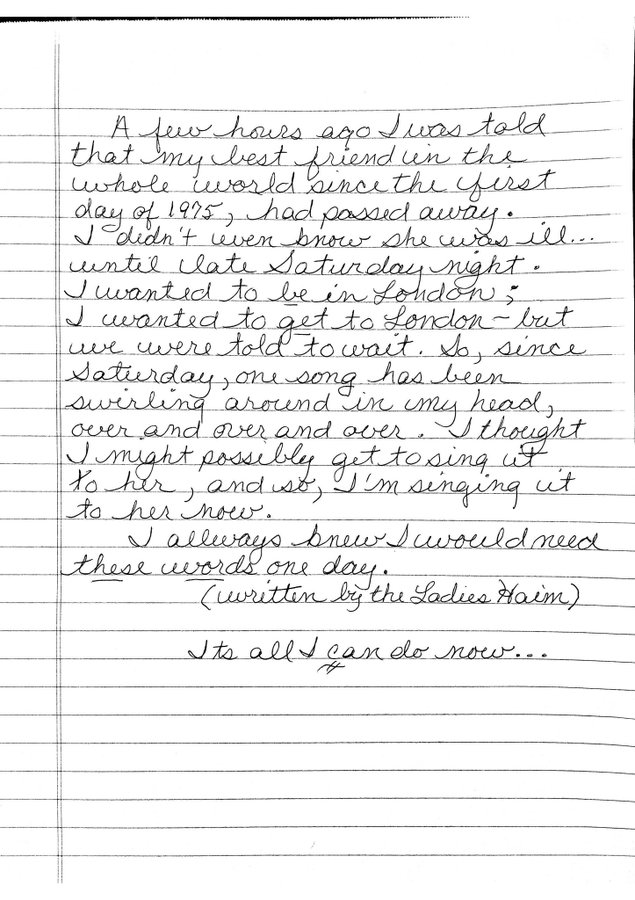
https://twitter.com/StevieNicks/status/1598065336611647491

 Image 

Image 

Image

Christine McVie’s Most Miraculous Song [theatlantic.com]

https://www.theatlantic.com/culture/archive/2022/12/christine-mcvie-fleetwood-mac-singer-death/672318/

Christine McVie’s Most Miraculous Song

“You Make Loving Fun” showed that the late Fleetwood Mac member was a titan in her own right.